

The rapid expansion of the new energy lithium battery industry has raised higher standards for production equipment stability, material conveying precision, and long-term operational efficiency. Lithium battery manufacturing involves the frequent conveying of high-fineness, high-hardness, and slightly corrosive electrode powders, including lithium iron phosphate, ternary materials, lithium carbonate, and other core raw materials. These powder materials feature fine particle size, high flow velocity, and continuous scouring characteristics, which pose severe abrasion and corrosion challenges to industrial conveying pipelines. Pipeline stability directly affects production continuity, material purity, production yield, and overall manufacturing costs of lithium battery factories.For a long time, most lithium battery production lines have adopted the traditional conveying scheme of 304 stainless steel pipes matched with glass liners. This conventional combination can meet basic short-term conveying demands but exposes prominent structural and performance defects in long-term continuous industrial operation. Severe pipeline wear, frequent elbow damage, short service life, and frequent shutdown replacement have become universal pain points restricting the high-efficiency operation of new energy lithium battery production lines. To solve these industry-wide problems,integral ceramic composite pipes have gradually become an upgraded and mainstream solution for lithium battery material conveying, relying on ultra-high wear resistance, excellent corrosion resistance, high-temperature stability, and low operation and maintenance costs.This article systematically analyzes the defects of traditional 304 stainless steel + glass conveying systems in lithium battery production, and comprehensively elaborates on the core advantages and application values of integral ceramic composite pipes in new energy lithium battery powder conveying scenarios, providing professional and practical equipment upgrading references for lithium battery manufacturing enterprises.
In the early stage of new energy lithium battery industry development, 304 stainless steel pipes with glass lining were widely used for powder material conveying due to their low initial procurement cost and simple installation. However, with the large-scale and continuous production of lithium battery factories, the performance limitations of this traditional scheme are fully exposed, bringing multiple negative impacts on production efficiency, product quality, and enterprise operating costs. The main existing problems are summarized as follows.
Lithium battery electrode powders are hard fine particles with strong abrasive properties. In the pneumatic conveying process, materials are driven by high-speed airflow to continuously scour and rub the inner wall of the pipeline. The glass lining adopted in traditional conveying systems has extremely poor wear resistance. Under the continuous pressure scouring of high-speed powder materials, the glass inner wall will gradually wear thin, peel off, and even crack. Actual production data shows that the average service life of glass lining in lithium battery powder conveying pipelines is only about 6 months.After the glass lining is worn and damaged, the 304 stainless steel matrix will be directly exposed to the powder scouring. The stainless steel wall also wears rapidly under long-term high-strength particle impact, which not only causes pipeline damage and material leakage but also leads to glass debris and metal powder mixing into the lithium battery raw materials, seriously affecting material purity and battery product performance, and reducing the qualified rate of finished products.
The lithium battery powder conveying system is composed of a large number of straight pipes and bent elbows, which need to realize multi-directional material transmission and process switching. In the pneumatic conveying mode, the high-speed gas-solid mixture changes its flow direction at the pipeline elbow, and the material particles produce concentrated impact and cutting friction on the outer wall of the elbow. The local instantaneous scouring intensity is far higher than that of straight pipe sections, making the elbow the most vulnerable and fastest-wearing part of the entire conveying system.For traditional glass-lined stainless steel elbows, the glass lining at the bending position is prone to concentrated wear, chipping, and local perforation in a short time. Many lithium battery factories even need to replace elbow parts every 3 to 4 months. The frequent damage of elbows leads to poor system tightness, unstable airflow pressure, and unsmooth material conveying, which becomes a key bottleneck restricting the stable operation of the entire production line.
Lithium battery manufacturing is a typical continuous and large-scale industrial production mode, which requires long-term uninterrupted operation of the conveying system. However, the traditional stainless steel and glass conveying system has a short service life and severe wear failure, resulting in extremely frequent pipeline inspection, maintenance, and replacement work. Each pipeline replacement requires production shutdown, disassembly, reinstallation, and system debugging, which occupies a lot of effective production time.Frequent shutdown maintenance directly reduces the effective operating time of the production line, resulting in a significant decline in enterprise output. Especially in the peak production season of new energy batteries, frequent pipeline failures will lead to delayed orders, insufficient production capacity, and reduced market competitiveness of enterprises.
Although the initial investment cost of 304 stainless steel + glass pipeline is low, the later comprehensive operating cost is extremely high. First, frequent pipeline and elbow replacement generates a large number of accessory procurement costs. Second, long-term maintenance requires professional personnel investment, increasing labor costs. Third, production shutdown losses caused by equipment failure far exceed the material cost of pipeline replacement. In addition, material waste and product quality degradation caused by pipeline wear and leakage further increase the invisible production cost of lithium battery enterprises.Moreover, the worn glass and stainless steel debris mixed into battery materials will cause batch unqualified products, bringing huge economic losses and after-sales risks to manufacturers. Therefore, the traditional conveying system can no longer adapt to the high-efficiency, low-consumption, and high-quality development needs of modern lithium battery production.
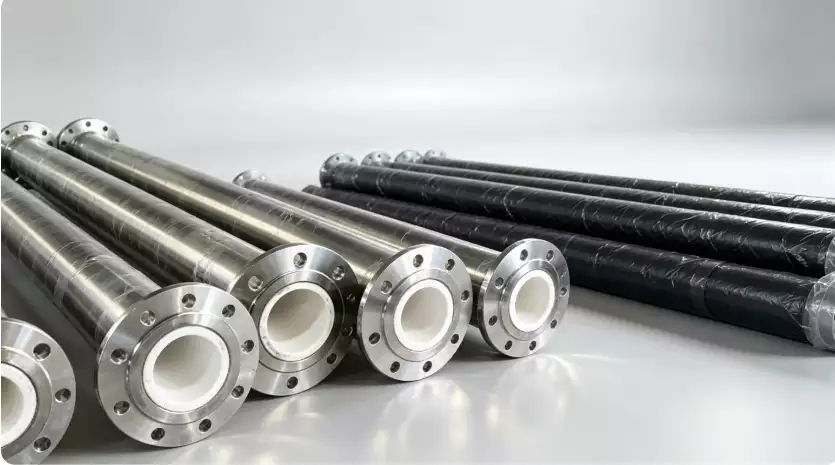
Aiming at the multiple pain points of traditional conveying systems in new energy lithium battery production, professional new energy anti-wear conveying equipment adopts a high-performance 304 stainless steel outer layer + integral wear-resistant ceramic inner lining composite structure. The outer 304 stainless steel pipe provides high structural strength, impact resistance, and installation stability, ensuring that the pipeline can withstand external mechanical extrusion and structural load during operation. The inner layer adopts high-purity alumina integral ceramic lining, which is bonded and fixed with special high-temperature ceramic adhesive after professional fine processing to form an integrated ceramic composite pipeline with seamless inner wall and firm bonding.Different from ordinary patch ceramic pipes, integral ceramic composite pipes have no gaps, steps, or dead corners on the inner wall. The integral firing and forming process makes the ceramic lining have uniform density, stable performance, and overall consistent wear resistance. The special ceramic adhesive has strong bonding strength, aging resistance, and temperature resistance, which can ensure that the ceramic lining does not fall off or peel off during long-term high-speed powder scouring, completely solving the peeling failure problem of traditional glass lining and patch ceramic lining. This optimized composite structure perfectly combines the structural advantages of stainless steel and the anti-wear and anti-corrosion advantages of ceramic materials, forming a targeted and efficient conveying solution for lithium battery powder materials.
Compared with the traditional 304 stainless steel + glass conveying scheme, the new ceramic composite pipe has comprehensive performance advantages in wear resistance, corrosion resistance, smooth conveying, load reduction, maintenance cost control, and high-temperature resistance, which fully adapts to the harsh working conditions of lithium battery powder conveying.
The inner lining of the integral ceramic composite pipe is made of high-purity alumina ceramic material with a hardness of HRA85-90, which has ultra-strong anti-scouring and anti-wear capabilities. Its wear resistance is more than 5 times that of traditional glass lining materials, and far exceeds that of stainless steel materials. In the long-term high-speed scouring working condition of lithium battery electrode powder, the ceramic lining can maintain stable structural integrity and surface smoothness for a long time, without wear, chipping, or peeling.After practical verification in many new energy lithium battery factories, the service life of integral ceramic composite pipes in powder conveying systems can reach more than 3 years, while the traditional glass lining pipeline fails in only 6 months. The service life is greatly extended, which fundamentally reduces the frequency of pipeline failure and replacement, and provides stable equipment support for continuous production of lithium battery lines.
Most lithium battery raw materials have weak acid and weak alkali corrosion characteristics, and the production environment is humid for a long time. Traditional glass lining is prone to chemical corrosion and aging peeling in corrosive medium environments, and 304 stainless steel will also produce slight oxidation and corrosion after long-term contact with special lithium materials, affecting material purity and pipeline service life.The integral ceramic lining has extremely stable chemical properties, does not react with lithium iron phosphate, ternary materials, lithium carbonate and other lithium battery raw materials, and can effectively resist weak acid and weak alkali corrosion and humid environment oxidation. It completely isolates the contact between the stainless steel outer layer and the conveying medium, avoids pipeline corrosion failure and material pollution, and ensures the high purity of lithium battery materials in the conveying process, which is crucial to improving the safety and cycle life of finished batteries.
The inner wall of the integrally formed ceramic pipe is dense and smooth, with an extremely low friction coefficient. Compared with the rough inner wall of glass lining and worn stainless steel pipes, the ceramic inner wall will not produce material hanging and residual accumulation. In the pneumatic conveying process of fine lithium powder materials, the smooth ceramic surface ensures unobstructed airflow and uniform material transportation speed, effectively prevents fine powder from adhering to the pipe wall and forming material accumulation, and avoids pipeline blockage problems.Stable and unblocked material conveying ensures the consistency of material feeding in each production link, stabilizes the proportion of battery raw material ingredients, and improves the overall uniformity and qualification rate of lithium battery products. At the same time, it reduces the manual cleaning work of blocked pipelines, saves maintenance time and labor costs, and improves the overall operating efficiency of the production line.
The integral ceramic composite pipe has a lightweight overall design. Compared with the thickened wear-resistant steel pipe and traditional glass-lined composite pipe, the ceramic composite pipe is lighter in weight under the same pipe diameter and pressure resistance. The lightweight structure greatly reduces the bearing load of pipeline supports, hangers, and overall production line equipment, reduces the structural pressure of factory equipment, and extends the service life of supporting equipment.In addition, the lightweight pipeline is more convenient for transportation, hoisting, and on-site installation, shortens the construction cycle of pipeline transformation and installation, minimizes the impact on normal production of lithium battery enterprises, and improves the economic benefit of equipment upgrading.
Relying on ultra-long service life and stable performance, integral ceramic composite pipes completely change the dilemma of frequent replacement of traditional pipelines. The number of pipeline maintenance and replacement is reduced by more than 80% every year, which saves a lot of accessory procurement costs, manual maintenance costs, and production shutdown losses for lithium battery enterprises.Although the one-time investment cost of ceramic composite pipes is slightly higher than that of traditional pipelines, the long-term comprehensive cost performance is extremely prominent. In the whole life cycle of 3-5 years, the use of ceramic composite pipes can reduce the comprehensive operating cost of enterprise conveying systems by more than 60%, which is an essential cost-saving and efficiency-enhancing upgrade for large-scale lithium battery production lines.
Part of the material conveying and pretreatment links in lithium battery production need to be carried out in a certain high-temperature environment. Traditional glass lining is prone to thermal expansion and contraction deformation, cracking and peeling in high-temperature environments, and the aging failure speed is accelerated. Ordinary stainless steel pipes are also prone to thermal deformation and structural instability under long-term high-temperature working conditions.The integral ceramic composite pipe has excellent high-temperature stability, which can operate stably for a long time in the temperature range of 150℃ to 300℃ without thermal deformation, cracking, or performance attenuation. The special high-temperature ceramic adhesive matched with the pipeline also maintains stable bonding strength in high-temperature environments, ensuring that the ceramic lining is firm and does not fall off. It fully adapts to the high-temperature process requirements of lithium battery material drying, conveying and pretreatment, and expands the application range of the conveying system.
With the continuous upgrading of new energy lithium battery production technology and the increasingly strict industry standards for product purity and production efficiency, the traditional low-performance conveying system can no longer meet the development needs of the industry. As a high-efficiency, wear-resistant, corrosion-resistant, and high-temperature resistant new energy special conveying equipment, integral ceramic composite pipes have solved many industry pain points in lithium battery powder conveying.At present, more and more medium and large-sized new energy lithium battery enterprises are gradually replacing traditional glass-lined stainless steel pipelines with integral ceramic composite pipes in material conveying systems, powder circulation pipelines, and elbow vulnerable parts. The practical application effect fully verifies its excellent performance advantages in improving production efficiency, stabilizing product quality, and reducing operating costs.In the future, with the continuous expansion of the new energy industry scale and the continuous improvement of equipment refinement requirements,integral ceramic composite pipes will be widely used in more new energy material conveying scenarios such as sodium-ion batteries, photovoltaic powder materials, and new energy thermal management systems, becoming a standard high-performance supporting equipment in the new energy manufacturing industry.
The traditional 304 stainless steel + glass conveying system has obvious defects such as short service life, serious elbow wear, frequent maintenance, high cost and easy material pollution in lithium battery production. The integral ceramic composite pipe adopts the advanced composite structure of stainless steel outer layer and integral ceramic inner lining, which perfectly solves all the pain points of traditional conveying equipment. It has prominent advantages of ultra-long wear-resistant life, acid and alkali corrosion resistance, smooth and anti-blocking conveying, lightweight and low load, low maintenance cost, and stable high-temperature operation.For new energy lithium battery enterprises, upgrading to integral ceramic composite pipes is not only an equipment optimization transformation, but also an important measure to stabilize production quality, improve production capacity, and reduce long-term operating costs. With its superior comprehensive performance, integral ceramic composite pipes have become the preferred solution for high-standard material conveying in the new energy lithium battery industry, and will continue to empower the high-quality and efficient development of the new energy manufacturing industry.

Submit your demand,
we will contact you ASAP.

Sanxin New Materials Co., Ltd. focus on producing and selling ceramic beads and parts such as grinding media, blasting beads, bearing ball, structure part, ceramic wear-resistant liners, Nanoparticles Nano Powder


 English
 English
 Russian
 French
 Spanish
 Portuguese
 Arabic