

Thermal power plants are the backbone of global electricity supply, yet they operate under some of the harshest material-handling conditions in modern industry. Among the most critical and failure‑prone subsystems are the pipelines that transport pulverized coal, fly ash, bottom ash, and desulfurization gypsum slurry. These media are abrasive, corrosive, and often conveyed at high velocities (15–25 m/s) and elevated temperatures (up to 200 °C or more). The result is relentless erosive wear, impact damage, and chemical attack that rapidly degrade conventional steel piping.
For decades, plant engineers have relied on carbon steel, alloy steel, or cast stone pipes, but these materials suffer from unacceptably short service lives—often less than one year in severe sections such as bends and reducers. Frequent replacements lead to exorbitant maintenance costs, unplanned outages, and reduced plant availability. The industry has long sought a solution that combines structural strength with extreme wear resistance.
That solution has arrived in the form of alumina ceramic‑lined steel composite pipes—a dual‑layer system that marries the toughness of steel with the hardness of engineering ceramics. Sanxin New Materials (叁鑫新材) has been at the forefront of developing and supplying these advanced pipes, helping power plants across China achieve order‑of‑magnitude improvements in pipeline longevity and operational reliability.
This article provides a detailed, technical exploration of how alumina ceramic‑lined steel pipes are applied in thermal power plant ash and pulverized coal conveying systems. We will cover the wear mechanisms, the composite pipe structure, manufacturing processes, specific application scenarios, performance data, economic benefits, and practical installation considerations—all backed by field experience and rigorous testing.
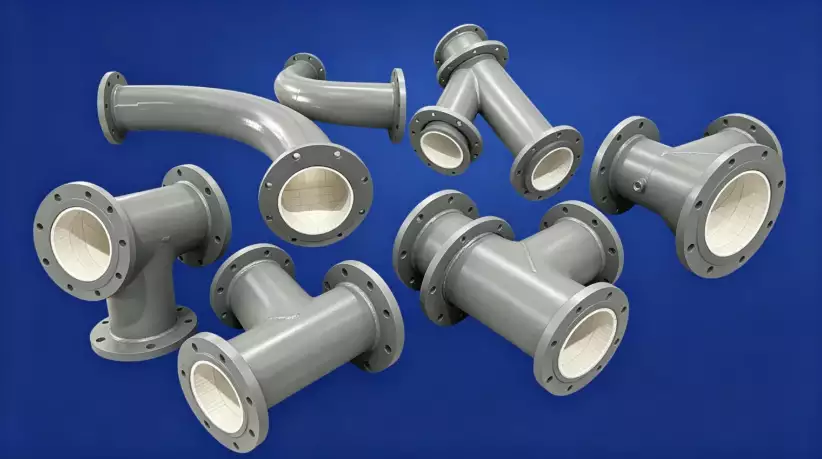
The primary damage mechanism in coal and ash conveying lines is solid‑particle erosion. Pulverized coal particles (typical size 50–200 µm) and fly ash (mostly spherical, 10–100 µm) impact the pipe wall at high speeds. The kinetic energy of each particle removes a tiny amount of material from the surface, leading to progressive thinning. In straight sections, erosion is relatively uniform, but at bends, elbows, and tees, the particle stream changes direction, causing concentrated impact and rapid wall penetration—often in a matter of months.
In addition to mechanical wear, pipelines are exposed to corrosive media. Pulverized coal often contains sulfur, and during combustion, sulfur oxides combine with moisture to form acidic condensates. In wet desulfurization (FGD) systems, limestone‑gypsum slurries are highly corrosive due to chlorides, sulfates, and low pH. These chemical agents attack steel surfaces, causing pitting, stress‑corrosion cracking, and general thinning, which accelerate failure.
Boiler start‑up and shut‑down cycles produce thermal expansion and contraction. Pipelines that are not designed to accommodate these stresses may develop fatigue cracks at weld joints. Additionally, the weight of the pipe and the dynamic forces from pneumatic conveying impose mechanical loads that can deform or misalign conventional pipes over time.
The cumulative effect of these factors is a short service life. Typical data from Chinese power plants show:
Ordinary carbon steel pipes in pulverized coal lines: 6–12 months before perforation.
Alloy wear‑resistant steel (e.g., 16Mn, NM400): 2–3 years in straight sections, but bends may fail within 1 year.
Cast basalt or stone pipes: improve life but are brittle and prone to cracking under thermal shock.
Each replacement requires system shutdown, draining, welding, and quality inspection—costing both direct materials and lost generation revenue. Plant operators recognise that a more durable solution is not merely desirable but essential for competitive operation.
Alumina ceramic‑lined steel pipes consist of two distinct layers that work synergistically:
Outer shell: Carbon steel (e.g., Q235, 20# steel) provides the mechanical strength to withstand internal pressure, external loads, and thermal expansion. It allows the pipe to be welded, flanged, and supported using standard power plant practices.
Inner lining: High‑purity alumina (Al₂O₃, typically >95%) ceramic is sintered at high temperatures to form a dense, extremely hard layer. The ceramic’s hardness (HRA 80–85, equivalent to HRC >70) far exceeds that of coal ash particles, ensuring that the wear surface remains intact for years. The lining is metallurgically or mechanically bonded to the steel, preventing delamination even under vibration and thermal cycling.
This combination leverages the best of both worlds: the ceramic takes the wear, while the steel takes the load.
Several production routes are used to create high‑quality ceramic‑lined pipes:
Self‑propagating High‑temperature Synthesis (SHS) Centrifugal Casting: This is the most common method for straight pipes. A mixture of aluminium and iron oxide is placed inside a steel pipe, which is then rotated at high speed. The exothermic reaction generates temperatures over 2000 °C, melting the reaction products. Under centrifugal force, the denser ceramic (alumina) migrates to the inner wall, while the metallic phase (iron) forms an intermediate bonding layer. The result is a uniform, metallurgically bonded ceramic lining with excellent adhesion and consistent thickness.
Centrifugal Casting with Pre‑placed Ceramic Powder: Similar to SHS but using pre‑sintered ceramic powder, this method also yields a dense lining with controlled thickness.
Adhesive‑Bonded Ceramic Tiles: For elbows, reducers, and custom fittings, pre‑formed alumina tiles are fixed to the inner surface using high‑temperature epoxy or inorganic adhesives. This allows precise coverage of complex geometries, ensuring that the most wear‑prone areas receive maximum protection.
Each method is selected based on the pipe size, shape, and service conditions, and Sanxin New Materials employs all of these to meet diverse customer requirements.
Alumina ceramic‑lined steel pipes from Sanxin New Materials have been deployed in virtually every abrasive conveying system within power stations. Below are the primary applications.
Primary air coal pipes – from coal mills to burners.
Secondary air and return coal pipes – for recirculation and fuel‑air mixing.
Coal feed chutes and transfer pipes – handling raw coal before pulverisation.
In these lines, the combination of high‑velocity air and sharp coal particles quickly erodes ordinary steel. Ceramic‑lined pipes typically achieve 8–10 years of service in straight sections and 5+ years in bends, compared to less than one year for steel. This dramatically reduces boiler trip risks caused by leaking coal pipes.
Dry fly ash conveying (pneumatic) – from electrostatic precipitators (ESPs) or bag filters to storage silos.
Bottom ash sluicing – hydraulic transport of heavy ash and slag from furnace hoppers.
Mixed ash and slag pipelines – where large, jagged particles cause both abrasion and impact.
Field data from multiple 600 MW units show that ceramic‑lined fly ash pipes last over 15 years with minimal wear, while standard steel replacements were needed every 18–24 months. The smooth ceramic surface also prevents ash build‑up, reducing blockages and preserving conveying pressure.
Wet FGD systems circulate limestone slurry and gypsum slurry, which are highly abrasive and corrosive due to the presence of solids and acidic components. Ceramic‑lined steel pipes are increasingly specified for:
Limestone feed lines
Absorber recirculation slurry pipes
Gypsum discharge and dewatering lines
The ceramic lining resists both the erosive wear from gypsum crystals and the chemical corrosion from low‑pH liquors, offering a service life 5–10 times longer than rubber‑lined or stainless‑steel alternatives.
In pneumatic conveying, bends are the most vulnerable points because particles impact the outer wall at high angles. Conventional steel elbows may fail in as little as 3–6 months. Sanxin New Materials offers prefabricated ceramic‑lined elbows with either integral SHS lining or tiled construction, extending bend life to 5–8 years. This single improvement can eliminate almost all unplanned maintenance in the ash conveying network.
To ensure the best protection for your specific fittings, we recommend consulting the range of high‑performance ceramic wear resistance parts designed for power plant applications.
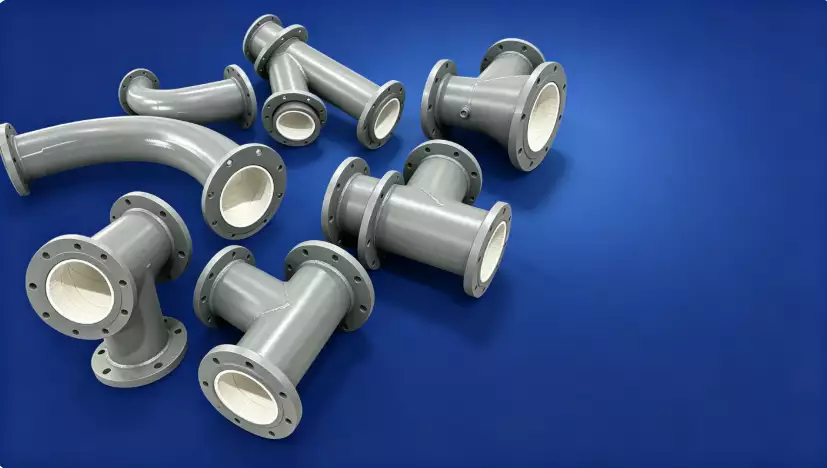
The hardness of alumina ceramic (HRA 80–85) is approximately 10 times that of quenched medium‑carbon steel and 3 times that of high‑chromium cast iron. In standard ASTM G65 dry sand/rubber wheel abrasion tests, ceramic‑lined steel shows a volume loss of <0.1 cm³, compared to >1.0 cm³ for wear‑resistant steel. In actual power plant service, this translates to a wear rate reduction of 80–95%.
The ceramic lining has an extremely smooth internal surface (Ra < 0.8 µm), far smoother than steel or cast basalt. This reduces the friction coefficient for both pneumatic and hydraulic conveying, leading to:
Lower pressure drop across the pipeline (typically 15–20% reduction).
Reduced fan or pump energy consumption.
Less tendency for ash or coal to adhere, minimising cleaning requirements and blockages.
Operating temperature range: The ceramic can withstand continuous temperatures from –50 °C to 800 °C without degradation. For power plant applications (typically <200 °C), it offers ample safety margin.
Thermal shock resistance: The composite design accommodates differential expansion; the ceramic does not crack even under rapid temperature changes of up to 300 °C.
Chemical inertness: Alumina is resistant to most acids, alkalis, and salt solutions, making it ideal for FGD slurries and acidic condensates.
A direct comparison of TCO over a 15‑year plant life reveals the economic superiority of ceramic‑lined pipes:
| Item | Conventional Steel | Alloy Steel | Alumina Ceramic‑Lined |
|---|---|---|---|
| Typical service life (straight) | 1 year | 2–3 years | 15+ years |
| Typical service life (bend) | 0.5 year | 1–2 years | 5–8 years |
| Number of replacements (15 yrs) | 15 | 5–7 | 1 |
| Maintenance labour cost | High | Moderate | Very low |
| Energy cost (due to friction) | Baseline | Baseline | ~15% lower |
| Downtime cost | Frequent outages | Occasional outages | Almost none |
Even with a higher initial investment (typically 2–3× the cost of steel), the long‑term savings are overwhelming. Many power plants report a payback period of less than 2 years after installation.
For critical applications where every component counts, Sanxin New Materials provides a full line of ceramic wear resistance parts that guarantee consistent performance and reliability.
Welding: The steel outer shell can be welded using standard procedures (SMAW, GMAW) with low‑hydrogen electrodes. Post‑weld heat treatment is generally not required, but care must be taken to avoid overheating the ceramic layer. Proper fit‑up and bevel preparation are essential to maintain alignment.
Flanged connections: For ease of replacement, flanged joints are preferred in sections that may need future access. The ceramic lining extends to the flange face to prevent step wear at joints.
Support spacing: Due to the higher density of ceramic‑lined pipes (approximately 20% heavier than steel alone), supports should be spaced appropriately to prevent sagging and excessive stress.
Ultrasonic thickness gauging can be applied to the steel outer wall to detect any loss of thickness (though in practice, the ceramic wears so slowly that steel erosion is negligible).
Visual inspection of bends and tees via inspection ports can reveal any lining damage; however, the ceramic is so durable that routine inspections can be extended to annual intervals.
Pressure and flow monitoring – a sudden increase in pressure drop may indicate blockage or lining failure, but such events are rare with ceramic systems.
In the unlikely event of localised damage (e.g., from a foreign object impact), repairs can be carried out by cutting out the damaged section and welding in a new ceramic‑lined spool piece. Alternatively, field‑repair kits with ceramic paste and tiles are available for small abrasion patches. However, most plants find that after 10–15 years of service, the entire pipeline is still in good condition, requiring only occasional cleaning.
This plant replaced its primary air coal pipes (DN200, total length 1.2 km) with SHS ceramic‑lined steel pipes from Sanxin New Materials. After 8 years of operation, thickness measurements showed an average ceramic wear of less than 0.5 mm (original thickness 8 mm). The plant reported zero unscheduled outages related to pipe failure, compared to an average of 3 such outages per year previously.
A 300 MW unit used conventional steel elbows that required replacement every 6 months. After fitting ceramic‑lined elbows (with adhesive‑bonded tiles), the first set lasted 7 years and was still operational when the plant upgraded its boiler. Maintenance costs dropped by 90%, and the conveying air pressure became more stable, improving ash removal efficiency.
In a wet FGD system, the gypsum discharge line suffered severe erosion‑corrosion, requiring replacement every 14 months. Sanxin New Materials supplied a ceramic‑lined pipe with a 10 mm thick alumina lining. After 4 years of service, inspection revealed only minor polishing of the ceramic surface, with no measurable wall loss. The plant extended its inspection interval from 3 months to annually.
These real‑world examples confirm that investing in high‑quality ceramic wear resistance parts is not merely a technical upgrade—it is a strategic decision that enhances plant profitability and operational security.
To understand why ceramic‑lined steel is often the optimal choice, it is useful to compare it with other common materials:
High‑chromium cast iron (e.g., Cr26): Good abrasion resistance but brittle and prone to cracking under thermal shock. It is also difficult to weld and repair.
Rubber‑lined pipes: Excellent for corrosion and moderate abrasion, but rubber can degrade at temperatures >80 °C and is susceptible to tearing from sharp particles.
Cast basalt pipes: Cheap but have low impact resistance and limited thermal shock tolerance; they are rarely used in pulverised coal systems due to cracking risk.
Ceramic‑lined steel: Combines the best hardness (from ceramic) with the toughness and weldability of steel. It outperforms all the above in high‑temperature, high‑velocity abrasive service, making it the material of choice for power plant conveying lines.
Beyond economic gains, ceramic‑lined pipes contribute to environmental protection and worker safety. Leaks from worn pipes can release coal dust or ash into the atmosphere, causing air pollution and potential health hazards. By virtually eliminating leaks, ceramic linings help plants comply with stringent emission standards. Additionally, reduced maintenance activities mean fewer hot‑work permits and confined‑space entries, lowering the risk of occupational injuries.
Sanxin New Materials (叁鑫新材) has earned a reputation for excellence in the field of advanced ceramic composites. Our commitment to quality is reflected in every stage of production:
In‑house R&D to continuously improve ceramic formulations and bonding technologies.
Rigorous quality control – every batch is tested for hardness, density, bonding strength, and thermal shock resistance.
Custom engineering – we provide detailed layout drawings, stress analysis, and installation guidance tailored to your specific plant layout.
Responsive after‑sales support – our technical team is available for on‑site inspections and troubleshooting.
We understand that power plants cannot afford downtime, and we design our products accordingly. Whether you need straight pipes, bends, reducers, or custom manifolds, our comprehensive portfolio of ceramic wear resistance parts ensures that every component meets the highest standards.
The harsh realities of ash and pulverised coal conveying demand a material solution that can withstand erosion, corrosion, and thermal cycling without frequent replacement. Alumina ceramic‑lined steel pipes have proven their worth in hundreds of thermal power plants across China and beyond, delivering service lives that are 10–20 times longer than conventional steel and 5 times longer than alloy alternatives.
From reducing unplanned outages to slashing maintenance budgets and improving environmental performance, the benefits are tangible and immediate. As the power industry continues to push for higher efficiency and lower emissions, the adoption of advanced wear‑resistant technologies like ceramic‑lined pipes will become not just an option, but a necessity.
Sanxin New Materials is proud to be a trusted partner in this journey, providing not only premium products but also the technical expertise to ensure successful implementation. We invite you to explore our full range of solutions and discover how our products can transform your ash and coal handling systems.
For detailed product specifications, application case histories, or to request a consultation, please contact our team today. Your path to a more reliable, cost‑effective power plant begins with the right wear protection—and we are here to help you every step of the way.
© 2026 Sanxin New Materials. All rights reserved.

Submit your demand,
we will contact you ASAP.

Sanxin New Materials Co., Ltd. focus on producing and selling ceramic beads and parts such as grinding media, blasting beads, bearing ball, structure part, ceramic wear-resistant liners, Nanoparticles Nano Powder


 English
 English
 Russian
 French
 Spanish
 Portuguese
 Arabic