

In large‑scale mining, metallurgy, coal preparation and thermal power industrial production scenarios, bulk material handling equipment represented by transfer chutes, receiving hoppers, crusher discharge ports and vibrating screen discharge ends faces extremely harsh dual damage of high‑speed abrasive scouring and heavy gravitational impact. In the process of continuous industrial operation, large‑diameter lump ores, coal gangue, mineral slag and hard gravel fall vertically from high drop heights, generating instantaneous strong impact force, while sharp and hard mineral particles continuously cut and scrape the inner wall of equipment. This long‑term cyclic superposition of impact load and sliding friction is the core cause of rapid failure of traditional equipment anti‑wear structures.For decades, industrial equipment engineers have been trapped in an unavoidable material selection dilemma in high‑impact and high‑wear working conditions. High‑hardness pure ceramic lining has superior anti‑abrasion and anti‑scouring performance, far exceeding metal materials, but its inherent brittleness makes it easy to crack, peel and collapse under repeated strong impact; pure rubber wear‑protection liner has excellent elastic buffering and shock absorption effects, which can effectively absorb impact energy, but its low surface hardness leads to poor wear resistance, and it is extremely easy to produce gouging wear and fatigue aging under long‑term cutting friction of hard minerals. Traditional manganese steel, high‑chromium cast iron and alloy steel wear‑resistant liner can withstand certain impact loads, but they have obvious defects such as easy deformation, poor corrosion resistance and short service life in complex working conditions, and cannot achieve long‑term stable protection effect.The performance defects of single‑material protective solutions directly lead to frequent equipment failures in industrial production, including liner fragmentation and falling off, inner wall perforation, material blockage and leakage, equipment vibration and noise overload. These problems force enterprises to arrange frequent shutdown maintenance, manual replacement of wearing parts and equipment debugging, resulting in a sharp increase in labor costs, spare parts procurement costs and invisible production shutdown losses, seriously restricting the continuous and efficient operation of production lines and reducing the overall economic benefits of enterprises. To completely break through the performance bottleneck of single‑material anti‑wear products and solve the industry pain point of “wear‑resistant materials are not impact‑resistant, impact‑resistant materials are not wear‑resistant”, Sanxin New Materials Co., Ltd has independently developed and optimized mature ceramic‑rubber‑steel three‑in‑one composite wear‑resistant liner. This product adopts integrated hot‑vulcanization molding process, organically integrating high‑hardness alumina ceramic anti‑wear layer, high‑elastic special rubber buffer layer and high‑strength steel support bottom plate, perfectly realizing the organic unity of super wear resistance and strong impact resistance, and filling the gap of high‑performance protective materials for complex working conditions of simultaneous impact and abrasion.This article comprehensively and systematically expounds the structural composition, core production process, professional performance parameters, unique technical advantages, applicable working condition boundaries, standardized installation specifications and actual engineering application effects of ceramic‑rubber‑steel composite liner. It provides authoritative and actionable technical reference and material selection basis for mine equipment managers, engineering procurement personnel and production transformation decision‑makers to select high‑quality wear‑protection liner and ceramic lining for high‑impact chute and hopper anti‑wear renovation projects.
Before the popularization and application of composite liner technology, industrial sites mainly relied on three traditional single‑material anti‑wear schemes to protect high‑impact equipment such as chutes and hoppers: pure alumina ceramic tiles, pure rubber thickened lining plates and metal alloy steel lining plates. Although these three schemes can meet the basic short‑term anti‑wear or anti‑impact needs, they all have insurmountable performance limitations in the face of complex working conditions with simultaneous heavy impact and strong abrasion, and cannot adapt to long‑term continuous industrial operation requirements.Pure alumina ceramic lining is sintered from high‑purity alumina raw materials at ultra‑high temperature, with Mohs hardness up to grade 9, excellent anti‑scouring and anti‑cutting performance, and its wear resistance is dozens of times that of traditional metal materials. However, ceramic is a typical brittle material with low fracture toughness. When subjected to repeated concentrated impact and instantaneous heavy load of large‑particle ore lumps, internal stress concentration is easy to occur, resulting in micro cracks, which gradually expand and lead to tile fragmentation, peeling and overall falling off. Once the local ceramic protective layer fails, the unprotected equipment steel base will be rapidly worn and perforated by high‑speed material scouring, expanding the damage range. Therefore, the ordinary adhesive pure ceramic wear‑resistant liner is only suitable for pure scouring working conditions without obvious impact load, and cannot be applied to key parts such as high‑fall blanking ports and chute turning impact zones.Pure rubber liner is made of high‑elastic industrial rubber material, which has good elastic deformation ability, can effectively absorb material impact kinetic energy, and has outstanding noise reduction and vibration damping effects. However, the inherent defect of low surface hardness of rubber determines its poor anti‑abrasion performance. Under the long‑term continuous cutting, scraping and grinding of sharp hard ore particles, the rubber surface is prone to gouging wear, layer thinning and local peeling failure. In high‑abrasion mining working conditions, the service life of pure rubber lining plate is extremely short, requiring frequent shutdown replacement and maintenance, which cannot meet the long‑term stable production needs of modern mines.Manganese steel and high‑chromium alloy steel wear‑resistant liner have high structural strength and can bear certain impact load, which is the most traditional industrial anti‑wear scheme. But metal materials are easy to produce plastic deformation and indentation under cyclic heavy impact, and abrasive grooves and fatigue pits will appear on the contact surface after a short period of operation. In addition, steel materials are susceptible to electrochemical corrosion and oxidation rust in humid mine water, mineral slurry and dusty environments. The coupling damage of wear and corrosion greatly accelerates the failure speed of metal lining plates. Although the initial procurement cost of metal liner is low, the comprehensive operation and maintenance cost accumulated by frequent replacement and shutdown maintenance in the later stage is extremely high. In view of the common defects of the above three single‑material products, the industry is in urgent need of a new generation of composite‑structurewear‑protection liner that balances wear resistance, impact resistance and corrosion resistance.
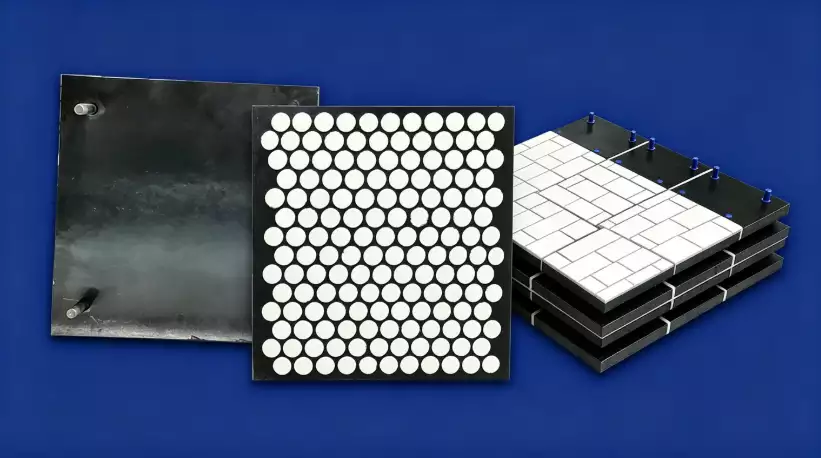
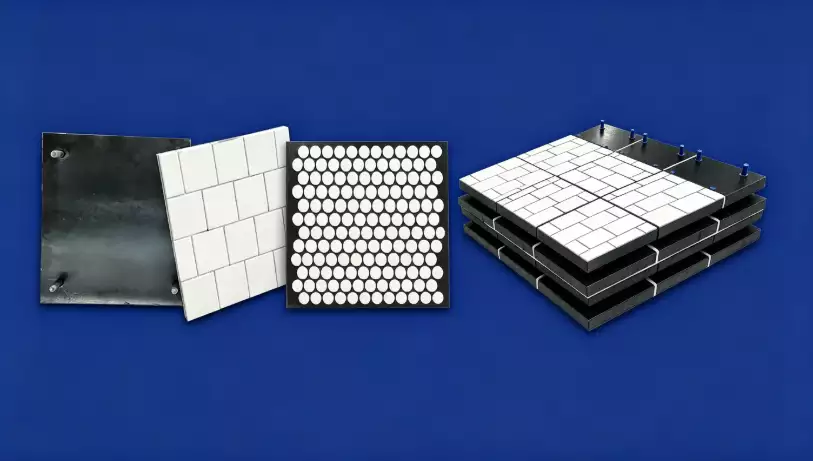
The ceramic‑rubber‑steel composite ceramic lining independently developed and produced by Sanxin New Materials Co., Ltd adopts a scientific three‑layer composite integrated structure, which is composed of surface high‑hardness alumina ceramic anti‑wear layer, middle high‑elastic special rubber buffer layer and bottom high‑strength steel plate support layer. Different from the simple glue bonding assembly method of ordinary imitation composite products in the market, this product adopts high‑temperature and high‑pressure hot‑vulcanization integral molding process. Through molecular cross‑linking reaction, the three layers of materials form an integrated whole with ultra‑high bonding strength, completely avoiding common failures such as interlayer degumming, delamination and peeling, and ensuring long‑term stable operation of the product in harsh working conditions.
The surface working layer is made of 92%‑95% high‑purity sintered alumina ceramic tiles, which are arranged in a precise staggered joint layout with extremely small gaps between tiles. The high‑density sintered alumina ceramic has Mohs hardness of grade 9 and Vickers hardness of 1500‑1800HV, with ultra‑strong anti‑abrasion, anti‑scouring and anti‑cutting capabilities, which can effectively resist the sliding friction and impact abrasion of hard ore, coal gangue and mineral slag. The smooth and dense ceramic surface has excellent non‑adhesive performance, which can completely avoid material adhesion, accumulation and arching blockage caused by rough inner wall of equipment. In the hot‑vulcanization molding process, each ceramic tile is firmly embedded in the rubber matrix, which greatly improves the overall fixing strength. Even if individual ceramic units are partially damaged by extreme impact, there will be no large‑area falling off of the protective layer, ensuring the continuity and integrity of equipment protection.
The middle buffer layer adopts Sanxin’s customized high‑toughness and anti‑aging special rubber formula, which is optimized for industrial high‑impact and multi‑temperature complex working conditions. This rubber layer is the core functional layer to solve the impact cracking problem of ceramic materials. When large lump materials fall and impact the equipment inner wall, the rubber layer produces uniform elastic deformation, efficiently absorbs and dissipates instantaneous impact kinetic energy, greatly reduces the impact pressure transmitted to the surface ceramic layer, and fundamentally avoids ceramic cracking and fragmentation failure. Professional test verification shows that the impact resistance of the composite liner can reach more than 35J/cm², and the shear bonding strength between rubber and ceramic, rubber and steel substrate is stably higher than 3.0MPa. The optimized rubber material has excellent wide‑temperature resistance, can maintain stable elastic buffer performance in the extreme temperature range of ‑50℃ to 120℃, and is not easy to age, harden or soften in cold winter, high‑temperature workshop and humid underground mine environments, adapting to all‑scenario industrial working conditions.
The bottom high‑strength steel plate serves as the overall structural support base of the composite wear‑resistant liner, providing stable mechanical bearing capacity for the entire protective structure. Standard reserved bolt holes are prefabricated on the steel plate surface, and the modular liner can be directly fixed on the inner wall of equipment through bolt fastening construction. Compared with the traditional pure adhesive installation method, the bolted fixing mode completely eliminates the hidden danger of lining plate falling off caused by adhesive aging, high‑temperature failure and humid water immersion failure. In the later stage of equipment operation, for individual worn liner modules, workers can disassemble and replace them separately without dismantling the overall equipment protection structure, which greatly shortens the maintenance cycle, reduces construction difficulty and minimizes production shutdown losses.
Sanxin New Materials Co., Ltd adopts advanced high‑pressure hot‑vulcanization integral molding technology for mass production of composite liners. The production process strictly follows standardized procedures: precise positioning and arrangement of ceramic tiles, quantitative injection of special rubber compound, accurate assembly of steel plates, and integrated molding in a constant‑temperature and constant‑pressure vulcanization mold. Under high temperature and high pressure conditions, the rubber material undergoes full molecular cross‑linking reaction, forming permanent and tight bonding with ceramic and steel interface. The integrated molding structure has no interlayer gap, no degumming hidden danger, stable overall performance, and completely overcomes the defects of easy delamination, peeling and short service life of cold‑bonded assembled composite products on the market.
Based on the scientific three‑material composite structural design, the ceramic‑rubber‑steel composite wear‑protection liner perfectly integrates the high wear resistance of alumina ceramic, the high impact resistance and shock absorption of special rubber, and the high structural stability of steel plate. It has comprehensive performance advantages that single ceramic, single rubber and single metal liner cannot match, and solves many long‑standing pain points in industrial equipment protection.
Perfect balance of ultra‑high wear resistance and heavy impact resistance: The surface alumina ceramic layer undertakes all anti‑abrasion and anti‑scouring work, resisting long‑term cutting and friction damage of hard mineral particles; the middle rubber buffer layer absorbs instantaneous impact energy of lump materials, avoiding ceramic cracking. It completely solves the industry dilemma that hard wear‑resistant materials are afraid of impact and soft impact‑resistant materials are easy to wear, and is perfectly suitable for complex working conditions where high abrasion and heavy impact coexist.
Efficient noise reduction and vibration damping, optimizing production environment: The elastic rubber layer can effectively buffer the violent collision and vibration generated by material falling impact, significantly reduce the operating noise and equipment vibration amplitude of chutes, hoppers and other equipment. It not only improves the on‑site industrial production environment, but also reduces the fatigue damage of equipment steel structure and connecting parts caused by long‑term cyclic vibration, and extends the overall service life of mechanical equipment.
Anti‑adhesion and anti‑blocking, improving material conveying efficiency: The dense and smooth surface of alumina ceramic lining does not absorb water or stick materials, and can effectively prevent the adhesion and accumulation of wet mineral powder, fine particles and viscous materials. It avoids equipment blockage, material arching and hanging wall problems that often occur in traditional metal and rubber lining equipment, reduces manual cleaning frequency and production interruption caused by blockage, and continuously improves the efficiency of bulk material conveying and processing.
Extreme weather resistance and super long service life: The optimized special rubber formula has excellent low‑temperature resistance, high‑temperature resistance and anti‑aging performance, and can operate stably in the extreme environment of ‑50℃ low temperature to 120℃ high temperature, adapting to seasonal temperature changes in northern and southern regions and complex indoor and outdoor working conditions. The overall composite structure has strong anti‑oxidation and anti‑corrosion ability, and the theoretical service life can reach more than 15 years under matched working conditions, which is 5‑10 times that of traditional metal liner and pure rubber liner.
Modular bolt installation, convenient maintenance and low comprehensive cost: The prefabricated modular wear‑resistant liner adopts bolt fixed installation, which does not rely on adhesive alone, with fast construction speed and no need for large‑scale equipment shutdown transformation. In the later operation and maintenance process, only individual worn modules need to be replaced, without overall disassembly, which greatly reduces maintenance labor, time and spare parts cost, and realizes long‑term cost reduction and efficiency improvement of enterprise equipment operation.
Ceramic‑rubber‑steel composite wear‑protection liner is specially customized for industrial complex working conditions with large‑particle materials, high‑drop blanking, frequent heavy impact and strong abrasive wear. It has been widely promoted and applied in many heavy‑industry fields such as mining, coal preparation, metallurgy, thermal power and building materials, and has achieved extremely excellent practical application results.In the mining and coal preparation industry, applicable core equipment includes mine raw coal bunkers, ore receiving hoppers, heavy‑duty material transfer chutes, crusher discharge hoppers, vibrating screen discharge boxes, mineral material diversion chutes and buffer silos. These equipment bear the long‑term impact of large lump ore and raw coal, and the internal wear and failure problem has always been a major difficulty in mine equipment maintenance. After adopting composite ceramic lining, the equipment failure rate is reduced by more than 80%, and the maintenance cycle is greatly prolonged. In the thermal power industry, composite liners are widely used in raw coal falling chutes, coal bunker bottoms, pulverizing system feeding hoppers and ash conveying equipment, solving the problems of rapid wear and frequent blockage of coal conveying system equipment. In the metallurgical industry, it is suitable for sintering plant material transfer hoppers, feeding buffer equipment and high‑temperature residue conveying chutes, adapting to the dual damage of material impact and medium corrosion.It is worth noting that Sanxin New Materials Co., Ltd has clear material selection logic for different working conditions. Composite wear‑resistant liner is the optimal solution for impact‑abrasion composite working conditions; for pure high‑speed scouring working conditions without obvious heavy impact, such as fine powder conveying pipelines and low‑drop flat chutes, ordinary adhesive pure ceramic tiles can achieve higher cost performance. Our professional technical team will conduct comprehensive parameter evaluation according to on‑site ore hardness, particle size distribution, material drop height, impact frequency, medium temperature and corrosivity, and scientifically recommend pure ceramic liner, alloy steel liner or three‑in‑one composite wear‑protection liner to ensure the best matching effect and economic benefit of the protection scheme.
Although the ceramic‑rubber‑steel composite liner has excellent product performance and modular convenient installation advantages, standardized on‑site construction and strict quality acceptance are still key links to ensure the maximum service life of the liner. Based on thousands of on‑site engineering renovation experiences, Sanxin New Materials Co., Ltd summarizes a complete set of standardized installation and acceptance specifications to guide on‑site construction.
Strict substrate pretreatment: Before installation, thoroughly clean the equipment steel base, completely remove surface welding slag, rust layer, oxide skin, oil stains and protruding burrs, polish the base surface flat and smooth, ensure that the composite liner is fully attached to the steel structure without gaps, and avoid hollowing and local stress concentration caused by uneven base.
Standard modular arrangement and gap reservation: According to the inner wall shape and material flow direction of the equipment, arrange the liner modules neatly and orderly. Reserve reasonable expansion gaps between adjacent liners to adapt to the thermal expansion and cold contraction deformation of steel structure and composite materials, preventing ceramic cracking and liner extrusion deformation caused by temperature change.
Standard bolt fastening and anti‑loose treatment: Use special matching high‑strength bolts for fixation, and fasten all bolts to the standard torque one by one. After the equipment trial operation for a period of time, re‑check and tighten the bolts to prevent bolt loosening and liner displacement caused by long‑term equipment vibration and material impact.
Comprehensive visual and tapping inspection: After the completion of installation, conduct full‑coverage inspection on all liner modules to ensure no warping, tilting, hollowing and dislocation. Confirm that the ceramic anti‑wear surface faces the material flow direction correctly, and eliminate all potential safety hazards of incomplete protection.
No‑load trial operation and final acceptance: Before formal feeding production, carry out 30‑60 minutes no‑load trial operation to check the operation stability of the liner. After confirming that all modules are firm and free of abnormal vibration and noise, formal material conveying production can be carried out to ensure the stability and reliability of the anti‑wear protection system.
A large number of domestic and foreign mining, thermal power and metallurgical engineering practice cases have fully verified the excellent application effect of ceramic‑rubber‑steel composite wear‑protection liner. After the traditional high‑impact equipment is renovated with composite ceramic lining, the common equipment failures such as liner fragmentation and falling off, rapid inner wall wear, equipment perforation, material blockage and leakage are completely solved. The frequency of equipment shutdown maintenance is reduced by more than 70%, the effective operation rate of the production line is significantly improved, and the comprehensive operation and maintenance cost of the equipment full life cycle is far lower than that of traditional manganese steel and pure rubber liner schemes.This three‑in‑one composite structure technology perfectly solves the long‑term technical contradiction between impact resistance and wear resistance in industrial equipment protection, breaks through the performance limitation of single‑material protective products, and provides a reliable and efficient anti‑wear protection solution for high‑impact and high‑abrasion complex working conditions. It not only helps enterprises reduce equipment maintenance labor and spare parts investment, but also avoids huge economic losses caused by production shutdown, and realizes dual improvement of production efficiency and economic benefits.Sanxin New Materials Co., Ltd has been focusing on the R&D, customized production and engineering technical services of industrial ceramic anti‑wear products for many years. Our product line covers modular wear‑resistant liner, composite anti‑wear lining series and various customized ceramic lining products. Facing diversified and complex industrial wear scenarios, our professional engineering team can provide targeted material selection guidance, structural scheme design and on‑site construction guidance according to customer on‑site working condition parameters, helping global industrial customers completely solve the problem of heavy‑impact equipment wear, realize stable and efficient operation of production equipment, and create greater production value for enterprises.

Submit your demand,
we will contact you ASAP.

Sanxin New Materials Co., Ltd. focus on producing and selling ceramic beads and parts such as grinding media, blasting beads, bearing ball, structure part, ceramic wear-resistant liners, Nanoparticles Nano Powder


 English
 English
 Russian
 French
 Spanish
 Portuguese
 Arabic