

Severe equipment abrasion caused by granular materials, slurry scouring, particle impact and medium corrosion is a universal pain point across heavy‑industry production lines. Traditional protection materials including manganese steel, alloy steel, cast stone and ordinary rubber liners often struggle to balance service life, impact resistance and chemical stability under harsh continuous operating conditions. Frequent maintenance, repeated component replacement and unplanned shutdown lead to high comprehensive operating costs for production enterprises. Against this background, high‑purity alumina wear‑resistant ceramic represented by wear‑resistant liner and modular ceramic lining have been widely promoted and applied in multiple industrial sectors.Sanxin New Materials Co., Ltd has accumulated rich on‑site project experience in the research, production and on‑site construction of alumina ceramic anti‑wear products. Compared with traditional metal wear‑resistant materials, qualified alumina‑based wear‑protection liner features ultra‑high Mohs hardness, excellent anti‑abrasion performance, stable chemical inertness and good high‑temperature resistance. Under the premise of scientific material grade selection and standardized installation process, the service cycle of industrial liner can reach 5‑8 years or even longer, greatly cutting down the frequency of equipment overhaul and replacement, and improving the continuity and safety of production system operation.Many industrial customers only know that alumina ceramics can resist wear, but lack systematic understanding of its applicable working conditions, equipment types and boundary limits of each industry. Blind application will cause problems such as ceramic sheet peeling, cracking and premature failure. This article sorts out the mature landing scenarios of alumina wear‑resistant ceramics in mining mineral processing, cement building materials, thermal power generation, port logistics, chemical industry and new‑energy material manufacturing, analyzes the working condition characteristics, typical equipment, material selection suggestions and common failure notes of each field, and provides practical reference for engineers, procurement personnel and project contractors to carry out anti‑wear transformation and new‑project supporting work.
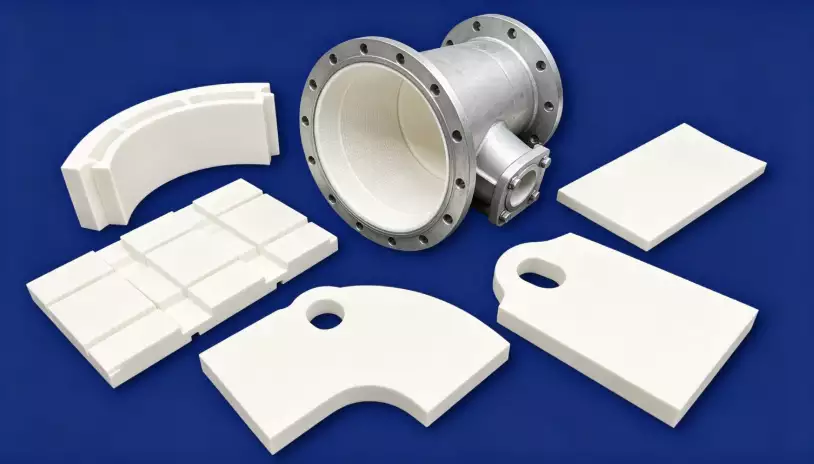
Mining and mineral processing is one of the earliest and most mature application industries for aluminawear‑resistant liner. In the whole process from raw‑ore feeding, crushing and grinding to flotation, tailings discharge, ore pulp circulatory transportation, solid particles with high hardness continuously scour and impact the inner wall of equipment. Metal pipelines, silos, hoppers, cyclones and chutes suffer extremely serious abrasive wear. Once the equipment wall is worn thin and perforated, it will cause material leakage, production interruption and even safety risks.In mineral processing plants, the typical equipment adopting ceramic lining covers raw‑ore silos, intermediate hoppers, collecting hoppers, transfer chutes, hydrocyclones, material distributing valves, stirring tanks, classifiers, tailings slurry pipelines, mineral pulp delivery pipelines, flotation machines and belt pulleys. For grinding equipment, modularwear‑protection liner is also widely matched with vertical fine grinding mills, horizontal ball mills, large mineral ball mills, Isamill, HiG Mill and SAG mill, effectively mitigating the wear of cylinder inner wall brought by grinding media and mineral particles.Working‑condition tips for mining industry: mineral particle size, slurry concentration, impact drop height and corrosive components in pulp shall be comprehensively evaluated. For scenarios dominated by slurry scouring and fine‑particle friction, 92%‑95% alumina liner can obtain good cost‑performance ratio. When there are large ore blocks and strong instantaneous impact, single pure ceramic tile is not suitable; it is recommended to select composite structural products such as ceramic‑rubber‑steel composite plates to absorb impact kinetic energy and avoid ceramic brittle fracture. In high‑acid or high‑alkali pulp environment, high‑purity alumina formula should be selected to enhance corrosion resistance of ceramic lining.From the perspective of actual project feedback, after adopting Sanxin New Materials Co., Ltd alumina wear‑resistant ceramic solutions, the service life of tailings and ore‑pulp pipelines is increased by 8‑12 times compared with ordinary steel pipes; the maintenance frequency of silos and chutes is greatly reduced, which effectively reduces the comprehensive maintenance cost of mineral‑processing enterprises.
Cement production is a typical process of large‑volume handling of hard mineral raw materials such as limestone, clay and clinker. Raw‑material crushing, pre‑homogenization, raw‑mill system, coal‑mill system, clinker conveying and ash‑discharging system all face continuous scouring from high‑hardness powder and granular materials, bringing severe wear risk to metal equipment inner wall. Alumina wear‑resistant liner has become a standard supporting anti‑wear component for many large and medium‑sized cement plants.In cement production workshops, ceramic lining is applied to limestone crushing chutes, raw‑material silos, batching hoppers, powder‑conveying pipelines, coal‑feeding pipes, cyclone separators, ash‑discharge elbows, mill inner walls and clinker buffer equipment. In raw‑mill and coal‑mill circulating pipelines, high‑speed powder produces strong friction on pipe walls. After laying wear‑protection liner or adopting ceramic‑lined composite steel pipes, the wear‑through cycle of pipelines can be greatly prolonged.Material‑selection suggestions for cement industry: most working conditions belong to medium‑high‑speed powder scouring with slight particle impact. 92%‑95% alumina liner is the mainstream choice. Attention should be paid to the temperature change of flue‑gas and hot‑material pipelines. For parts with long‑term high‑temperature environment, high‑temperature special adhesive must be used in the installation of ceramic lining to prevent glue layer aging and tile falling off. In clinker conveying links with large‑particle impact, thickened ceramic tiles or composite liners are recommended.
Coal‑fired thermal‑power plants produce a large amount of fly ash and bottom ash during power generation. Pulverized‑coal conveying pipelines, ash‑slag conveying pipelines, ash‑separation cyclones, material‑collecting hoppers, desulfurization‑system pipelines and dust‑removal equipment are eroded by high‑speed ash particles for a long time. Thin‑wall steel pipes are easy to be worn and perforated, resulting in ash leakage, polluting the plant environment and affecting the stable operation of units. Alumina wear‑resistant liner is widely used in anti‑wear transformation of thermal‑power auxiliary systems.The elbows and tee joints in ash‑conveying pipelines are the most severely worn positions, which are key protection objects for ceramic lining. For large‑volume ash‑storage silos and buffer hoppers, laying modular wear‑protection liner can effectively slow down inner‑wall abrasion. In the flue‑gas desulfurization system, besides particle wear, there is also weak corrosive medium erosion, so the formula grade of liner should be properly upgraded.Sanxin New Materials Co., Ltd reminds thermal‑power customers that thermal expansion difference between metal matrix and ceramic shall be considered in design and installation. In high‑temperature flue‑gas pipelines, reasonable gap shall be reserved for the splicing of ceramic lining to avoid ceramic cracking caused by thermal stress. For pneumatic ash‑conveying pipelines with extremely high material flow rate, high‑density sintered alumina products are preferred to reduce abrasion loss rate.
Port terminals undertake a huge amount of bulk‑material transshipment business including coal, ore, grain and building‑material raw materials. Belt conveyors, transfer chutes, buffer hoppers, silos, feeding pipes and vibrating‑screen auxiliary components bear continuous impact and friction of bulk materials. Traditional metal plates need frequent repair and welding. Alumina wear‑resistant liner provides long‑term stable protection for port bulk‑material equipment.Port working conditions are characterized by large material‑handling capacity and frequent large‑particle impact. Pure adhesive‑bonded single ceramic tile is only suitable for parts dominated by scouring. For the transfer point with heavy impact, ceramic‑rubber‑steel composite ceramic lining is more appropriate. Rubber layer can absorb impact force, ceramic layer provides wear resistance, and steel substrate guarantees structural strength. This composite‑structure wear‑protection liner solves the contradiction between impact resistance and wear‑resistance for port equipment well.
Chemical production process often accompanies particle conveying, solid‑liquid mixing and medium corrosion. Equipment such as reaction‑material chutes, slurry circulating pipelines, cyclone separators and storage tanks not only suffer particle scouring wear, but also face erosion from acid, alkali and salt media. The selection of liner in chemical industry must take both wear‑resistance and corrosion‑resistance into consideration.Under weak‑acid and weak‑alkali environment, 95% alumina ceramic lining can meet most working‑condition requirements. When encountering strong‑corrosion medium, 99% high‑purity alumina material is recommended to reduce internal impurity phase and improve chemical stability. Sanxin New Materials Co., Ltd can provide customized‑size wear‑resistant liner according to the drawing of chemical equipment to realize full‑coverage protection of irregular equipment inner wall.
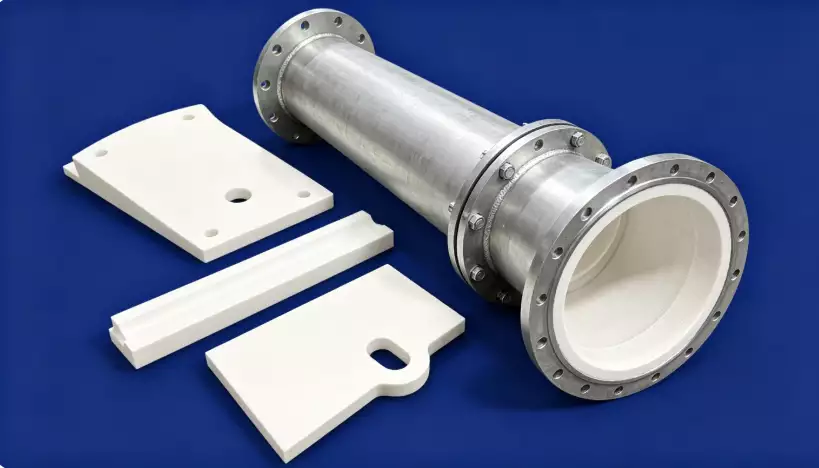
In lithium‑battery positive‑and‑negative‑material production, equipment inner‑wall abrasion will introduce metal impurities, which seriously affect product quality. Metal and ordinary alloy liners are easy to produce metal pollution. High‑purity alumina wear‑protection liner can avoid impurity mixing while resisting powder scouring, which has become an important supporting component for new‑energy material production lines.In material‑conveying pipelines, mixing tanks and screening equipment of battery‑material factories, high‑purity ceramic lining effectively reduces the risk of iron‑impurity pollution. In this industry application, special attention should be paid to the surface finish and dimensional tolerance of liner. Excessive burrs and dimensional deviation will cause powder accumulation and cross‑contamination.
Good product quality is only one part of successful project landing. Correct material‑grade matching and standardized construction are equally important for the service life of wear‑resistant liner. Many failure cases are not caused by ceramic‑product quality itself, but result from mismatched material selection or non‑standard installation.First of all, material selection should not only pursue high‑purity blindly. For ordinary scouring‑dominated working conditions, 92% alumina ceramic lining has excellent cost‑performance. For impact‑intensive sites, it is necessary to give priority to composite‑structure <a href="https://www.beadszirconia.com/products/ceramic-wear-protection‑liner instead of simply increasing ceramic purity. Secondly, the surface of steel substrate must be thoroughly derusted and cleaned before installation; oil stain and rust will seriously reduce bonding strength and lead to tile peeling. Thirdly, corresponding supporting accessories shall be selected according to working temperature: ordinary adhesive cannot be used for long‑term high‑temperature working conditions, and high‑temperature special glue is required. The splicing gap of liner shall be reserved reasonably to adapt to thermal‑expansion deformation.Enterprises should communicate with technical suppliers in detail, sort out key parameters including material particle size, impact strength, operating temperature, medium corrosivity and equipment vibration amplitude, so as to obtain targeted wear‑protection liner matching scheme, rather than copying the application scheme of other factories mechanically.
Alumina wear‑resistant ceramics represented by various specifications of wear‑resistant liner and ceramic lining have achieved large‑scale full‑scenario landing in mining mineral‑processing, cement building‑materials, thermal‑power, port bulk‑logistics, chemical industry and new‑energy material manufacturing. Its core value lies in extending equipment service life, cutting down maintenance workload, reducing unplanned‑shutdown loss and lowering comprehensive operating cost for industrial enterprises.As a professional manufacturer, Sanxin New Materials Co., Ltd integrates R&D, production and project technical service. We provide standard and customized wear‑protection liner and complete ceramic anti‑wear solutions for global industrial customers. We support drawing customization, on‑site technical guidance and scheme optimization according to actual working‑condition parameters, helping customers realize stable and efficient operation of production equipment in various complex wear‑scenarios.

Submit your demand,
we will contact you ASAP.

Sanxin New Materials Co., Ltd. focus on producing and selling ceramic beads and parts such as grinding media, blasting beads, bearing ball, structure part, ceramic wear-resistant liners, Nanoparticles Nano Powder


 English
 English
 Russian
 French
 Spanish
 Portuguese
 Arabic