

Mining, thermal‑power generation, metallurgy, cement manufacturing and chemical industries face severe equipment wear challenges in bulk‑material handling workflows. Hoppers, transfer chutes, silos, cyclones, crusher discharge sections and material pipelines continuously suffer combined damage including high‑speed particle scouring, high‑drop lump ore impact, long‑time mechanical vibration and mild acid‑alkali medium corrosion. Inner‑wall abrasion, perforation, material caking and frequent shutdown for liner replacement become universal pain points that raise operational expenditure and disturb continuous production schedules.
Traditional single‑material protective panels all have obvious bottlenecks in practical field operation. Pure ceramic lining delivers outstanding hardness and anti‑corrosion capacity, yet intrinsic brittleness easily causes tile cracking, chipping and peeling under heavy concentrated impact. Ordinary rubber sheets feature good shock‑absorbing performance, but sharp mineral particles will cut rubber surfaces quickly, leading to aging and shortened service cycle. Manganese steel and alloy steel plates own reliable impact‑resistance, while insufficient surface hardness results in rapid thinning under persistent abrasive scouring. Simple glue‑bonded composite products rely only on physical adhesion between layers; under repeated vibration and temperature alternation, they tend to suffer delamination, degumming and large‑area falling‑off, which greatly lowers actual service lifespan.
Unexpected shutdown triggered by liner failure brings multi‑dimensional losses for heavy‑industry enterprises, covering spare‑parts procurement cost, manual replacement labor, production halt loss, material leakage risk and environmental remediation expense. To break the performance trade‑off dilemma of single‑material protective components, Sanxin New Materials Co., Ltd develops high‑performance wear‑protection liner adopting integrated high‑temperature thermal‑vulcanization composite craft. The ceramic‑rubber‑steel three‑in‑one composite liner integrates high‑hardness alumina ceramic layer, elastic modified rubber buffer layer and load‑bearing carbon steel substrate, realizing complementary advantages of rigid and flexible materials. This article systematically interprets its layered‑structure mechanism, core manufacturing‑craft highlights, multi‑dimensional performance strengths, working‑condition adaptability, installation specifications and full‑lifecycle economic value, providing practical technical reference for global industrial customers on equipment upgrading and new‑project material selection.
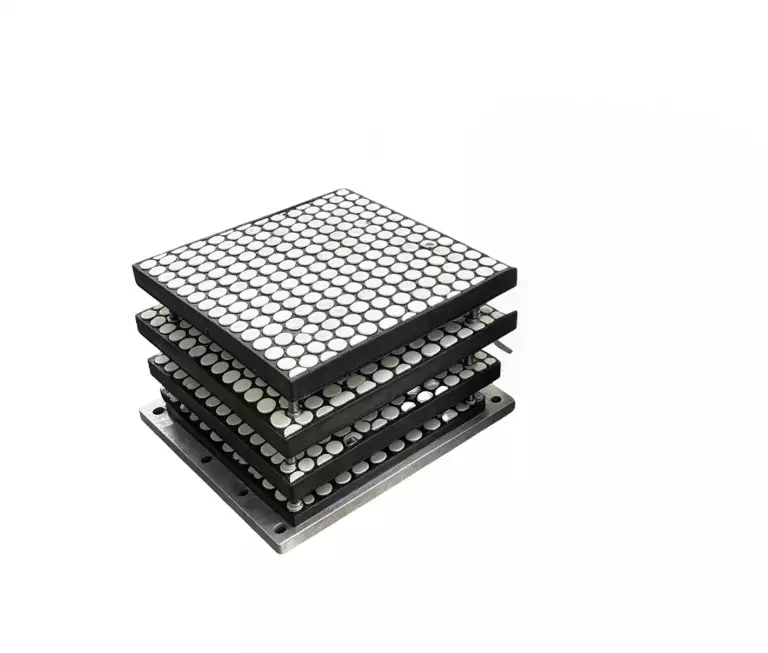
The core competitiveness of ceramic composite liner roots in its scientific three‑layer integrated architecture, instead of simple physical stacking of heterogeneous materials. Sanxin New Materials adopts proprietary high‑temperature thermal‑vulcanization one‑piece molding process, which tightly combines high‑purity alumina ceramic tiles, modified intermediate rubber layer and Q235 carbon steel base plate into an integral component. No obvious gaps exist between functional layers, effectively avoiding common inter‑layer separation risks seen in ordinary glue‑bonded composite products. Every functional layer undertakes clear divided‑labor tasks and cooperates mutually to cope with complex multi‑factor wear environments.
The surface working layer consists of high‑purity 92%‑95% alumina ceramic tiles. After high‑temperature pressureless sintering, the ceramic reaches Rockwell hardness HRA 85‑90, far higher than manganese steel and common alloy‑steel materials. Compact and smooth ceramic surface resists persistent micro‑cutting and particle scouring generated by ore lump, coal ash and cement clinker. Meanwhile, ultra‑low surface roughness greatly restrains material adhesion and caking, solving frequent blockage trouble for silos and transfer chutes. According to diverse equipment geometry, square, hexagonal, circular and special‑shaped ceramic tiles can be customized to realize seamless full‑coverage protection for flat, cambered and irregular inner walls. This ceramic surface constitutes the core anti‑abrasion barrier of wear‑resistant liner.
The intermediate modified rubber buffer layer acts as the key energy‑absorbing core. Optimized special rubber formula improves elasticity, fatigue‑resistance and anti‑aging capacity. When bulk raw materials fall from high altitude and generate instantaneous heavy‑impact load, the rubber layer absorbs and disperses most impact energy through elastic deformation, protecting brittle surface ceramic tiles from crack and chipping damage. Besides impact buffering, the rubber layer also delivers prominent vibration‑damping and noise‑reduction functions. It can lower equipment operation noise by 12‑15 decibels, optimizing harsh workshop working environments for mining, power and metallurgy sites.
The bottom substrate adopts premium Q235 carbon‑steel plate, which provides overall structural rigidity and installation foundation for composite liner. The steel base owns high mechanical strength and anti‑deformation performance, capable of bearing external equipment load and construction collision. Pre‑reserved bolt holes and welding edges are designed on steel‑plate surface, supporting two mainstream installation modes: bolt fastening and spot‑welding fixation. Compared with single ceramic lining or two‑layer ceramic‑rubber composite without steel backing, three‑in‑one composite plate possesses stronger overall stability, higher installation firmness and wider working‑condition adaptability.
Every material layer cannot work independently. Only when ceramic anti‑abrasion layer, rubber buffer layer and steel supporting layer combine closely via mature vulcanization craft, can the whole set of ceramic lining give full play to comprehensive performance under compound wear‑and‑impact scenarios.
Manufacturing craft determines the actual service effect of ceramic‑rubber‑steel composite liner. Many early‑stage failed cases in industrial sites do not stem from raw‑material defects, but result from backward bonding technology. Traditional glue‑bonding or mechanical‑laminating methods only produce simple physical attachment among three materials. Under long‑time alternating cold‑hot circulation, frequent mechanical vibration and repeated material impact, adhesive layers will gradually age and fail, triggering degumming, tile‑falling and liner delamination within short service cycles.
Sanxin New Materials applies mature one‑piece thermal‑vulcanization molding technology. Under constant temperature condition of 150‑170 ℃ and pressure of 10‑15 MPa, the composite keeps curing for 30‑60 minutes. Under high‑temperature and high‑pressure environment, rubber molecules produce stable chemical‑bond connection with ceramic tile surface and steel‑plate surface, instead of superficial physical sticking. This molecular‑level fusion mode dramatically promotes inter‑layer peeling strength of finished composite liner, reaching above 15 MPa. Even under long‑term working‑condition circulation of vibration, impact and temperature fluctuation, the three‑layer structure can remain integrated without delamination risk.
Another prominent advantage of thermal‑vulcanization craft lies in flexible performance customization. According to different customer‑site working‑condition parameters including material hardness, lump‑size distribution, drop‑height and impact intensity, Sanxin technical team can adjust rubber hardness formula, ceramic‑tile thickness and ceramic‑arrangement density during vulcanization production. For heavy‑impact mining chute positions, we configure high‑toughness modified rubber and thickened ceramic tiles; for moderate‑abrasion thermal‑power coal‑drop hoppers, we adopt cost‑balanced material collocation. This flexible adjustment mode realizes targeted product matching for diverse industrial scenarios, avoiding over‑specification or insufficient‑performance selection.
Strict factory‑process quality‑control runs through the whole vulcanization workflow. Raw‑material incoming inspection covers ceramic‑tile hardness test, rubber‑formula performance verification and steel‑plate dimensional checking. Semi‑finished‑product sampling test monitors vulcanization temperature, pressure and holding‑time parameters. Finished‑product inspection includes appearance checking, inter‑layer peeling‑strength sampling test and dimensional tolerance verification. Each batch of composite liner products is attached with complete inspection report, supporting third‑party detection for overseas mining, power and metallurgy projects.
Benefiting from reasonable three‑layer composite‑structure plus mature thermal‑vulcanization craft, Sanxin ceramic composite liner obtains multi‑dimensional comprehensive performance that single‑material protective plates cannot achieve.
First is the balance of wear‑resistance and impact‑resistance. High‑purity alumina ceramic surface provides excellent anti‑abrasion property; its wear‑resisting capacity is 10‑20 times higher than ordinary manganese‑steel plates. Meanwhile, intermediate rubber layer effectively disperses instantaneous impact force from falling ore and bulk material, solving the fatal brittleness shortcoming of pure ceramic lining. It realizes “ceramic resists abrasion, rubber absorbs impact” rigid‑flexible coordinated protection, perfectly coping with working‑conditions where abrasion and heavy impact coexist.
Second is stable temperature‑adaptability and anti‑corrosion property. Qualified composite liner can keep stable comprehensive performance within ‑40 ℃ ~ 100 ℃ long‑term continuous operating‑temperature range, adapting to seasonal cold‑hot alternation of outdoor mining and thermal‑power sites. Compact alumina ceramic possesses good chemical inertness, resisting erosion of most weak‑acid and weak‑alkali ore‑slurry, fly‑ash and process medium. Rubber isolating layer separates raw‑material medium from steel substrate, preventing steel‑plate rusting and further avoiding secondary material pollution caused by metal‑rust peeling.
Third is anti‑caking and noise‑reduction value. Ultra‑smooth ceramic surface greatly reduces material adhesion probability. In silos, hoppers and chutes, it lowers manual cleaning frequency and avoids blockage faults which disturb material conveying continuity. Rubber buffer layer absorbs collision vibration generated during bulk‑material feeding, lowering equipment operation noise and meeting modern green‑production requirements of heavy‑industry enterprises.
Fourth is lightweight property and diversified installation compatibility. The overall weight of ceramic‑rubber‑steel composite liner is only one‑third of traditional solid steel protective plate. Lightweight characteristic reduces dead‑load burden for hopper and chute equipment body. Reserved bolt holes and welding edges support bolt fastening or local spot‑welding installation. It can adapt to flat surface, large‑radian cambered surface and special‑shaped equipment inner‑wall structures, bringing great convenience for both new‑project manufacturing and old‑equipment renovation.
Field engineering feedback shows that compared with traditional manganese‑steel liner, Sanxin three‑in‑one composite liner can lift equipment‑protective‑part service life by 8‑10 times in typical mining and thermal‑power heavy‑wear working‑conditions, sharply cutting frequent shutdown maintenance frequency and improving overall production continuity.
Ceramic‑rubber‑steel composite liner targets heavy‑abrasion plus medium‑to‑high‑impact industrial scenarios, widely deployed in mining, thermal‑power generation, metallurgy, cement building‑material and partial chemical‑industry fields.
In mining industry, it serves ore‑receiving hoppers, transfer chutes, crusher discharge ports and tailings‑recycling silos. Large‑size ore lumps fall with high drop‑height and bring strong instantaneous impact. Composite liner gives play to dual advantages of wear‑resistance and buffering‑impact, solving the pain point of rapid wear of manganese‑steel plates and easy cracking of pure ceramic tiles. For super‑large lump‑impact special‑working‑conditions, technical team can customize thickened‑tile and high‑elastic‑rubber formula to strengthen comprehensive protective capacity.
In thermal‑power industry, composite liner is applied for coal‑drop chutes, coal‑conveying‑system transition sections and ash‑storage hoppers. It restrains coal‑ash adhesion and caking, reduces pipeline blockage risk, lowers auxiliary‑system maintenance workload, and guarantees stable operation of boiler unit.
In metallurgy and cement‑building‑material industry, raw‑material silos, feeding chutes and transfer‑point equipment suffer long‑time scouring from high‑hardness clinker, mineral raw‑materials and slag. Composite liner’s anti‑abrasion and anti‑corrosion performance extends equipment inner‑wall service cycle and cuts down spare‑parts consumption.
Even though composite liner owns prominent comprehensive advantages, it still has clear application boundaries and cannot adapt to all extreme working‑conditions. Restricted by rubber‑material performance, long‑term continuous operating‑temperature shall not exceed 100 ℃; for working‑conditions above 120 ℃, pure ceramic lining or high‑temperature alloy wear‑resistant materials are recommended. Alumina ceramic cannot resist long‑time erosion of hydrofluoric acid and high‑concentration strong‑alkali medium. For special‑corrosion chemical‑industry scenarios, silicon‑carbide‑series wear‑resistant products shall be selected after material‑adaptability test. Meanwhile, although rubber buffer improves impact‑resistance, composite liner still cannot bear unlimited continuous striking from oversized sharp ore blocks. Pre‑screening process should be optimized to control maximum incoming‑material lump‑size.
Combined with abundant engineering‑project experience, Sanxin New Materials puts forward practical material‑selection guidance: ceramic‑rubber‑steel three‑in‑one composite liner is preferred for working‑conditions with both abrasive scouring and medium‑high impact. For pure‑scouring slight‑impact positions, customers can select two‑layer ceramic‑rubber composite plate to control project investment cost. For high‑temperature, strong‑corrosion and ultra‑heavy‑impact extreme‑scenarios, communicate with our engineers deeply to choose ZTA toughened‑ceramic or silicon‑carbide‑series customized wear‑resistant solutions.
When carrying out equipment‑renovation and new‑project procurement, many enterprise decision‑makers pay close attention to one‑time purchasing cost. The unit price of ceramic‑rubber‑steel composite liner is higher than ordinary manganese‑steel plate and single rubber liner. Nevertheless, product cost‑performance shall be evaluated from full‑lifecycle dimension instead of only focusing on initial procurement expense.
The full‑lifecycle comprehensive cost of equipment protective liner includes multi‑items: product procurement expense, transportation‑and‑installation cost, spare‑parts reserve cost, daily maintenance labor cost, shutdown‑loss expense triggered by liner sudden‑failure, and environmental‑risk cost brought by material leakage. Traditional single‑material liners feature short service cycle and need repeated replacement, leading to continuous accumulation of spare‑parts and labor expenditure. More importantly, unplanned shutdown loss caused by liner wear‑through and damage is extremely huge for concentrator, power‑plant and cement‑plant production lines. Short‑time production halt will generate direct and indirect economic losses often far exceeding the procurement fund of protective‑liner itself.
Take a medium‑sized non‑ferrous‑metal concentrator as practical reference case. Its ore‑receiving chute originally adopts manganese‑steel liner plates, partial replacement is needed every 8‑10 months with high annual maintenance expenditure. After upgrading to Sanxin ceramic‑rubber‑steel composite liner, the continuous service cycle of chute liner extends to more than 4 years, annual maintenance workload reduces over 70 %, and unplanned shutdown incidents caused by liner failure are basically eliminated. Calculated under 5‑year full‑lifecycle dimension, comprehensive operation‑and‑maintenance cost drops by around 38 % compared with the original manganese‑steel scheme.
Apart from direct cost‑reduction, composite liner also brings multiple implicit benefits. Anti‑adhesion ceramic surface reduces manual silo‑and‑chute‑cleaning frequency and saves labor resources. Vibration‑damping and noise‑reduction effect optimizes workshop on‑site environment, complying with modern enterprise occupational‑health and green‑production standards. Stable equipment‑protective performance guarantees continuous production rhythm and promotes overall factory throughput.
Sanxin New Materials insists on providing customized matching‑solution rather than blind full‑liner‑coverage recommendation. According to customer‑site actual parameters such as material characteristics, lump‑size, drop‑height, medium‑corrosiveness and equipment structure, technical team carries out targeted tech‑economic analysis. We retain cost‑effective traditional materials for low‑wear auxiliary positions and deploy high‑performance composite liner on key high‑wear and high‑impact sections, realizing optimal balance between project input and long‑term operation benefit.
Bulk‑material‑handling equipment in mining, thermal‑power, metallurgy and building‑material industries has long‑time suffered composite damage including particle abrasion, lump‑fall impact, mechanical vibration and medium corrosion. Traditional single‑material protective liners are hard to balance wear‑resistance, impact‑resistance, anti‑corrosion and economy, becoming a major bottleneck restricting low‑cost and stable operation of heavy‑industry production lines.
Sanxin New Materials Co., Ltd’s ceramic‑rubber‑steel composite liner breaks through performance limitations of single‑material via scientific three‑layer composite‑structure plus mature high‑temperature thermal‑vulcanization integrated‑molding craft. Surface high‑purity alumina ceramic layer undertakes efficient anti‑abrasion and anti‑corrosion tasks; intermediate modified rubber layer realizes energy‑absorbing buffering and noise‑reduction; bottom steel‑plate layer guarantees structural stability and flexible installation. Reasonably deployed composite liner effectively solves common premature‑failure troubles of industrial‑equipment protective parts, greatly prolongs equipment service life, cuts down maintenance frequency and unplanned‑shutdown risks, and creates remarkable full‑lifecycle economic returns for global industrial customers.
Final service effect of composite liner is comprehensively decided by raw‑material quality, vulcanization manufacturing‑craft, factory quality‑control and standardized on‑site construction. Industrial users shall not only focus on single‑item material‑performance index, but also combine actual‑working‑condition parameters including material property, impact strength, operating‑temperature and medium‑corrosion for comprehensive material‑selection assessment. As a professional manufacturer of industrial wear‑resistant ceramics, Sanxin New Materials integrates R&D, production and sales, providing global customers with product customization, working‑condition‑matching consultation, installation‑guidance and full‑cycle after‑sales technical‑support. Along with continuous upgrading of global heavy‑industry intelligent and energy‑saving production, ceramic‑rubber‑steel composite liner will gain broader application prospects in equipment‑protection renovation and new‑construction projects.

Submit your demand,
we will contact you ASAP.

Sanxin New Materials Co., Ltd. focus on producing and selling ceramic beads and parts such as grinding media, blasting beads, bearing ball, structure part, ceramic wear-resistant liners, Nanoparticles Nano Powder


 English
 English
 Russian
 French
 Spanish
 Portuguese
 Arabic