

Bulk material conveying, material bunker storage, crushing and sorting constitute the most fundamental and high‑frequency production procedures in modern mining, thermal‑power generation, metallurgy, building materials and chemical industries. Core equipment including transfer chutes, receiving hoppers, storage silos, feeding boxes and material conveying pipelines operates continuously throughout the production cycle, and their inner protective liners are exposed to extremely complex and harsh comprehensive wear environments. Different from single abrasion damage, industrial equipment lining suffers from multi‑dimensional coupled damage including high‑speed particle scouring, high‑altitude bulk material falling impact, long‑term mechanical vibration, material adhesion clogging and weak chemical medium corrosion, which has always been a key factor restricting stable production and increasing operating costs for industrial enterprises.For a long time, the global heavy industry has been trapped in an unavoidable material selection dilemma for wear‑resistant liners. Traditional single protective materials have obvious performance shortcomings and cannot adapt to diversified harsh working conditions. Ordinary manganese steel and alloy steel plates have good impact resistance, but their surface hardness is limited, resulting in fast abrasive thinning and short service life, requiring frequent shutdown replacement. Pure alumina ceramic liners have excellent wear resistance and corrosion resistance, but their inherent brittleness makes them prone to cracking, chipping and peeling under high‑strength concentrated impact and vibration. Conventional rubber liners feature outstanding shock absorption and anti‑slip performance, yet they are easily cut and aged by sharp hard particles, and fail rapidly under high‑temperature and long‑term scouring conditions. In addition, composite plates with simple glue bonding process are prone to delamination, degumming and tile falling after long‑term operation, with poor overall stability.Frequent lining failure brings a series of cascading negative impacts on industrial production. Equipment inner wall wear‑through will directly cause material leakage, dust overflow and material blockage, seriously affecting production efficiency and on‑site environmental safety. Regular shutdown maintenance and liner replacement consume a large amount of manpower, material and financial resources, while unplanned emergency shutdowns caused by sudden lining damage will lead to greater economic losses, disrupting the overall production schedule of the factory. To solve the industry‑wide pain point of “wear‑resistant not impact‑resistant, impact‑resistant not durable, durable with high cost”, wear‑protection liner represented by ceramic‑rubber‑steel three‑in‑one composite plates has become an upgraded mainstream solution for heavy‑duty industrial equipment protection.Sanxin New Materials Co., Ltd (叁鑫新材), relying on years of industrial ceramic R&D and production experience, optimizes the integrated high‑temperature thermal vulcanization composite process to independently develop and produce high‑performance ceramic‑rubber‑steel composite plates. The product realizes rigid‑flexible collaborative protection, combining the super wear resistance of alumina ceramics, the efficient buffering and shock absorption of modified rubber, and the structural stability of steel plates. This article comprehensively elaborates the structural principle, core performance advantages, multi‑industry application scenarios, standardized installation process, quality control points and full‑life‑cycle economic value of the composite plate, providing systematic and professional technical reference for equipment renovation and new project material selection for global heavy‑industry customers.
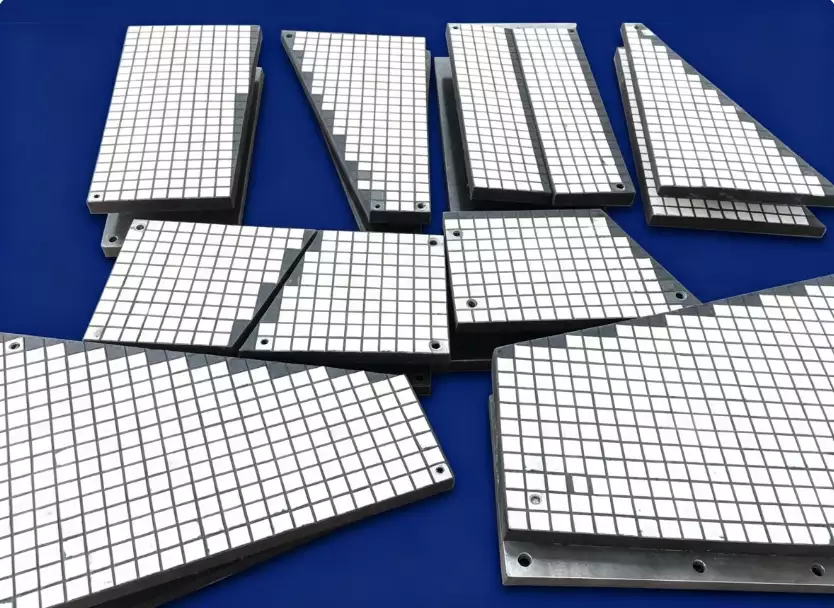
The ceramic‑rubber‑steel three‑in‑one composite plate adopts one‑piece high‑temperature thermal vulcanization molding technology, which perfectly bonds three functional layers with different performance characteristics into an integral structure without gaps and delamination risks. The overall structure is divided into surface wear‑resistant ceramic layer, middle elastic buffer rubber layer and bottom load‑bearing steel plate layer. Each layer has clear functional division and complementary advantages, completely breaking through the performance limitations of single‑material protective plates, and is the core competitive advantage of high‑quality wear‑resistant liner.The surface working layer is made of high‑purity 92%‑95% alumina ceramic tiles professionally produced by Sanxin New Materials. After high‑temperature sintering and precise polishing, the ceramic tile has a Rockwell hardness of HRA 85‑90, which is far higher than manganese steel, alloy steel and rubber materials. The dense and smooth ceramic surface can effectively resist continuous cutting and scouring of hard mineral particles, coal slag, cement raw materials and chemical powders. Meanwhile, the ultra‑smooth surface greatly reduces material adhesion and caking, thoroughly solves the problem of frequent blockage of silos, chutes and conveying pipelines, and ensures smooth material transportation. According to different working condition characteristics and equipment structures, we can customize square, hexagonal, circular and special‑shaped ceramic tiles to achieve full coverage and seamless protection of equipment inner walls.The middle layer is high‑strength modified vulcanized rubber, which is the key buffer structure of the composite plate. Different from ordinary rubber materials, the modified rubber formula optimized by Sanxin New Materials has excellent elasticity, fatigue resistance and aging resistance. When bulk materials fall from high altitude and generate instantaneous strong impact force, the rubber layer absorbs and disperses most of the impact energy through elastic deformation, avoiding brittle cracking and peeling of the surface ceramic layer caused by rigid impact. In addition, the rubber buffer layer has outstanding vibration damping and noise reduction functions, which can effectively reduce the mechanical vibration of equipment during operation, reduce on‑site operating noise by 12‑15 decibels, and significantly improve the harsh working environment of industrial workshops.The bottom layer adopts high‑quality Q235 carbon steel plate as the load‑bearing base, which provides overall structural rigidity and installation foundation for the composite plate. The steel substrate has high mechanical strength and strong deformation resistance, which can bear external equipment load and construction impact. At the same time, reserved bolt holes and welding edges are designed on the steel plate surface, supporting flexible modular installation to adapt to various complex equipment structures. Compared with single ceramic lining and two‑in‑one ceramic‑rubber plates without steel base, the three‑in‑one composite plate has stronger overall stability, higher installation firmness and wider working condition adaptability.In terms of production technology, Sanxin New Materials strictly controls every link of thermal vulcanization compounding. The interlayer peeling strength of the integrally molded composite plate is more than 30 N/mm², which can effectively resist interlayer delamination caused by long‑term equipment vibration, material impact and temperature fluctuation. The product can maintain stable comprehensive performance in the temperature range of ‑40 ℃ to 100 ℃, avoiding common defects such as rubber aging, degumming and ceramic tile falling of traditional glued composite products. From the perspective of wear failure mechanism, the composite structure perfectly solves the three major failure problems of industrial protective liners: ceramic resists abrasive wear, rubber buffers impact fatigue, and steel plate stabilizes the structure, greatly extending the service life of wear‑protection liner under complex working conditions.
The mining industry is the most typical heavy‑impact and high‑abrasion working scenario. In the processes of ore dumping, conveying and crushing, large‑particle ores fall from a high drop height, causing strong instantaneous impact and continuous abrasive scouring on equipment such as receiving hoppers, transfer chutes, crusher discharge ports and tailings recycling silos. Traditional manganese steel plates wear through rapidly and need frequent replacement; pure ceramic liners are easy to crack and peel under heavy impact, resulting in poor protection effect and high comprehensive operating cost.Sanxin New Materials ceramic‑rubber‑steel composite plates are perfectly adapted to mining harsh working conditions. The surface alumina ceramic layer resists long‑term abrasive scouring of ore particles, the middle rubber buffer layer absorbs huge impact energy generated by ore falling, and the bottom steel plate ensures the overall structural stability of the lining. A large number of mine engineering practices show that the service life of composite plates is 4‑6 times that of traditional manganese steel liners, which greatly reduces the frequency of equipment maintenance and lining replacement. For special working conditions with super‑large ore lump impact, our technical team can customize thickened ceramic tiles and high‑elasticity rubber formulas to further enhance the impact resistance of the lining, realizing long‑term stable protection of mining equipment.
The coal transportation, coal dropping and ash removal systems of thermal power plants have been plagued by fine particle abrasion and material accumulation for a long time. Equipment such as coal conveying pipelines, coal drop chutes, ash storage hoppers and ash slag transfer bins are scoured by pulverized coal, fly ash and ash slag mixtures for a long time. Fine solid particles cause continuous micro‑abrasion on the inner wall of the equipment, and material adhesion and caking often occur on the inner wall of traditional steel liners, resulting in increased pipeline resistance, reduced conveying efficiency and increased fan energy consumption.The ceramic‑rubber‑steel composite plate perfectly solves the pain points of thermal power working conditions. The ultra‑smooth ceramic surface effectively inhibits coal ash adhesion and accumulation, avoids pipeline blockage, and ensures the efficient operation of coal handling and ash removal systems. The rubber buffer layer reduces equipment operation vibration and noise, improving the on‑site working environment. The overall wear resistance and corrosion resistance of the composite plate greatly reduce the failure rate of equipment inner wall thinning and perforation. At present, many domestic and foreign thermal power plant renovation projects have adopted our modular composite plates to replace traditional manganese steel liners, which significantly reduces the maintenance workload of auxiliary systems and guarantees the continuous and stable operation of boiler units.
Metallurgical steelmaking and cement building material production processes will produce a large number of high‑hardness raw material particles, accompanied by weak acid and alkali corrosive media. Traditional steel liners are prone to rust and wear under the coupled action of wear and corrosion; ordinary rubber liners are easily scratched and aged by sharp hard particles, with short service life and poor protection effect.The alumina ceramic layer of Sanxin composite plates has excellent chemical inertness, which can effectively resist the erosion of most weak corrosive process media. The modular design is flexible and diverse, which can be perfectly adapted to raw material silos, feeding chutes, conveying transfer points and special‑shaped curved equipment of metallurgical plants and cement plants. The three‑layer rigid‑flexible composite structure integrates wear resistance, corrosion resistance and impact resistance, which comprehensively improves the protection level of building materials and metallurgical equipment, reduces equipment failure rate, and extends the service cycle of production equipment.
In the chemical industry, bulk powder conveying silos and material transfer equipment often face moderate material impact and weak corrosive medium erosion. Ordinary protective materials are difficult to balance wear resistance and corrosion resistance. The high‑density alumina ceramic layer of ceramic‑rubber‑steel composite plates can resist chemical medium erosion, the rubber layer buffers material impact, and the steel plate base ensures installation structural strength, providing stable and reliable inner wall protection for chemical conveying equipment. It is worth noting that composite plates are not suitable for extreme working conditions of strong hydrofluoric acid corrosion and long‑term high temperature above 100 ℃. For special corrosive working conditions, professional material matching tests are required before large‑scale application.
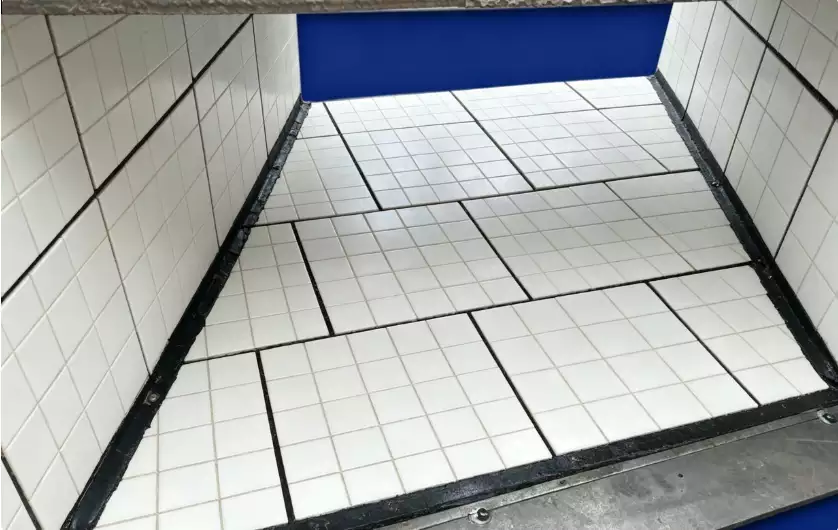
The excellent performance of ceramic‑rubber‑steel composite plates depends on high‑quality production and standardized on‑site construction. Unqualified quality control and irregular installation will easily lead to premature failure of the lining and affect the overall protection effect. Sanxin New Materials implements strict full‑process quality inspection before factory delivery to ensure that all products meet industrial high‑standard application requirements. The factory inspection items include ceramic tile appearance inspection, hardness test, dimensional accuracy detection, interlayer peeling strength sampling test and steel substrate quality inspection, to eliminate defective products such as cracked tiles, missing corners and unbonded layers. Each batch of products is equipped with a complete material inspection report to provide quality assurance for customer projects.In the links of product transportation and on‑site hoisting, violent knocking, heavy extrusion and sharp collision are strictly prohibited. Although the outer steel plate can protect the inner structure, excessive local impact will cause hidden cracks in the ceramic layer, laying hidden dangers for later use. We recommend using soft slings for hoisting, and reasonably controlling the stacking height of finished products to avoid compression damage of bottom plates.The composite plate supports two mainstream on‑site installation methods: bolt fastening and steel plate spot welding fixation, which are suitable for different equipment structures and construction environments. During bolt installation, it is necessary to align the reserved mounting holes accurately and tighten the bolts evenly to avoid local stress concentration causing plate deformation and ceramic cracking. During welding construction, only spot welding is allowed on the edge of the bottom steel plate. High‑temperature welding operations close to the rubber layer are strictly prohibited to prevent rubber scorching, aging and degumming. For curved equipment inner walls, flexible composite plates with good bending adaptability should be selected to avoid forced distortion installation, which will cause internal stress damage to the wear‑resistant liner.After the completion of on‑site installation, comprehensive acceptance inspection must be carried out. Check whether the ceramic surface is intact, whether the gaps between adjacent plates are uniform and reasonable, and ensure no bare steel exposure on the equipment inner wall. In daily production operation, avoid ultra‑large hard foreign objects from directly impacting the lining surface. During regular equipment shutdown maintenance, conduct visual inspection and troubleshooting in time. Once individual ceramic tiles are chipped or partially peeled, local replacement and repair should be carried out immediately to prevent small‑area damage from expanding into large‑area delamination and failure, ensuring long‑term stable operation of the equipment protective lining.
In terms of one‑time procurement cost, the unit price of ceramic‑rubber‑steel composite plates is slightly higher than that of ordinary manganese steel plates and single rubber liners. However, industrial enterprises cannot judge the cost performance of products based solely on initial investment. It is necessary to evaluate the comprehensive economic benefits from the perspective of full life cycle including procurement, installation, maintenance, replacement and production loss.The full‑life‑cycle comprehensive cost of equipment lining covers multiple expenditures such as product procurement, transportation and installation, spare parts reserve, daily maintenance labor, and production shutdown loss caused by lining failure. Traditional single‑material liners have short service life and frequent replacement, resulting in continuous repeated investment in spare parts and maintenance labor. More importantly, unplanned production shutdowns caused by sudden lining wear‑through and damage will bring huge indirect economic losses, which are often far higher than the material procurement cost.Taking a medium‑sized non‑ferrous metal concentrator as a practical case, the ore receiving chute originally adopts manganese steel lining plates, which need partial replacement every 8‑10 months, with annual maintenance and replacement costs remaining high. After upgrading to Sanxin New Materials ceramic‑rubber‑steel composite plates, the continuous service life of the chute lining is extended to more than 4 years, the annual equipment maintenance workload is reduced by more than 70%, and unplanned shutdown accidents caused by lining failure are completely eliminated. Calculated based on a 5‑year full life cycle, the comprehensive operation and maintenance cost of the equipment is reduced by about 38% compared with the traditional manganese steel scheme.In addition to direct cost reduction, the composite plate also brings multiple implicit benefits. The anti‑adhesion performance of the ceramic surface reduces the frequency of manual cleaning of silos and chutes, saving labor costs. The vibration damping and noise reduction effect optimizes the workshop production environment and meets industrial green production standards. The stable and efficient operation of equipment improves the overall production efficiency of the factory. Sanxin New Materials adheres to customized matching solutions, not blind full‑coverage installation. According to customer’s actual working condition parameters such as material particle size, drop height, medium characteristics and equipment structure, our technical team provides targeted technical and economic analysis, retains cost‑effective single‑material liners for low‑wear parts, and deploys high‑performance composite plates for key high‑wear and high‑impact parts, realizing the optimal balance between project investment and long‑term benefit.
As a new generation of rigid‑flexible collaborative protective material, ceramic‑rubber‑steel composite plates have comprehensive performance advantages, but they still have clear application scope and limitations. Accurate material matching according to working conditions is the key to giving full play to product performance and avoiding engineering selection risks.First of all, limited by the temperature resistance of modified rubber materials, the long‑term continuous operating temperature of the composite plate should not exceed 100 ℃. In high‑temperature working environments above 120 ℃, the rubber layer will accelerate aging, lose elasticity and buffering performance, resulting in reduced overall protection effect. For high‑temperature equipment protection scenarios, it is recommended to choose pure ceramic lined steel plates or high‑temperature resistant alloy wear‑resistant materials.Secondly, alumina ceramic materials cannot resist the long‑term erosion of strong hydrofluoric acid and high‑concentration strong alkali media. For special chemical working conditions with extreme corrosive media, pre‑use material adaptability tests are required, and silicon carbide wear‑resistant products can be selected as an alternative solution.Third, although the rubber buffer layer greatly improves the impact resistance of the lining, the composite plate still cannot withstand continuous ultra‑large sharp ore block impact without limit. For working conditions with excessive ore particle size, it is necessary to optimize the pre‑screening and pre‑crushing process to control the maximum particle size of incoming materials, reduce instantaneous strong impact load, and protect the integrity of the composite lining.Combined with years of engineering practice and customer feedback, Sanxin New Materials summarizes professional matching suggestions: ceramic‑rubber‑steel three‑in‑one composite plates are the preferred solution for working conditions with both abrasion and medium‑high impact, including mine ore receiving chutes, thermal power coal drop pipelines, metallurgical raw material silos and other key equipment. For pure scouring working conditions with slight impact, two‑in‑one ceramic‑rubber composite plates can be selected to control project cost. For high‑temperature, strong corrosion and ultra‑high impact extreme working conditions, communicate with our technical engineers in depth to select ZTA toughened ceramics, silicon carbide and other customized wear‑resistant solutions to ensure safe and stable equipment operation.
Bulk material conveying and storage equipment in mining, thermal power, metallurgy, building materials and chemical industries have long faced composite damage problems such as particle abrasion, falling impact, mechanical vibration and medium corrosion. Traditional single‑material protective liners are difficult to balance wear resistance, impact resistance, corrosion resistance and economy, which has always been a major pain point restricting the efficient and low‑cost operation of industrial production.The ceramic‑rubber‑steel composite plate launched by Sanxin New Materials Co., Ltd breaks through the performance limitations of single materials through a scientific three‑layer composite structure and mature high‑temperature thermal vulcanization process. The surface high‑purity alumina ceramic layer undertakes efficient anti‑abrasion and anti‑corrosion work, the middle modified rubber layer realizes energy absorption, buffering and noise reduction, and the bottom steel plate layer ensures structural stability and convenient installation. The reasonably configured wear‑protection liner effectively solves the common failure problems of industrial equipment lining, greatly extends equipment service life, reduces maintenance frequency and unplanned shutdown risks, and creates significant full‑life‑cycle economic benefits for industrial enterprises.The final service effect of composite plates is comprehensively determined by raw material quality, production process, factory quality control and standardized on‑site installation. Industrial users should not only focus on single material performance indicators, but also combine actual working condition parameters such as material characteristics, impact strength, operating temperature and medium corrosion to carry out comprehensive material selection evaluation. As a professional manufacturer of industrial ceramic wear‑resistant products, Sanxin New Materials integrates R&D, production and sales, providing global customers with product customization, working condition matching consultation, on‑site installation guidance and full‑cycle after‑sales technical support. With the continuous upgrading of global industrial intelligent and energy‑saving production, ceramic‑rubber‑steel composite plates will be more widely used in equipment protection renovation and new construction projects, empowering the high‑quality development of heavy industry.

Submit your demand,
we will contact you ASAP.

Sanxin New Materials Co., Ltd. focus on producing and selling ceramic beads and parts such as grinding media, blasting beads, bearing ball, structure part, ceramic wear-resistant liners, Nanoparticles Nano Powder


 English
 English
 Russian
 French
 Spanish
 Portuguese
 Arabic