

In mining, thermal‑power generation, metallurgy, cement manufacturing and chemical processing industries, material‑handling equipment such as transfer chutes, storage silos, conveying pipelines, hoppers and cyclones are continuously subjected to particle scouring, abrasive friction, material impact and mild chemical corrosion. Equipment inner‑wall abrasion, local perforation, material caking and frequent shutdown maintenance have long troubled plant operation and procurement teams. Traditional wear‑resistant solutions including carbon steel, stainless steel, high‑chromium cast iron, manganese‑steel alloy, cast stone and rubber lining are widely adopted on‑site, yet each of these conventional materials has obvious inherent performance defects, leading to short service cycles, high maintenance workload and rising comprehensive operating costs.
Against the background of global industrial pursuit of quality improvement and cost reduction, high‑purity alumina wear‑resistant ceramics are rapidly replacing many traditional wear‑resistant materials. As a mature new‑generation protective solution, wear‑resistant liner and ceramic lining produced by Sanxin New Materials Co., Ltd achieve balanced performance in wear resistance, corrosion resistance, temperature adaptability and installation flexibility. More importantly, they bring substantial full‑lifecycle economic benefits for heavy‑duty production facilities. This article systematically compares alumina ceramics with multiple mainstream traditional wear‑resistant materials, analyzes their respective advantages, weaknesses and applicable boundaries, and explains why alumina‑based ceramic components have turned into preferred options for industrial equipment anti‑abrasion renovation projects. This technical article serves as practical reference for metallurgists, equipment engineers and procurement managers when selecting wear‑protection liner and anti‑abrasion spare‑parts.
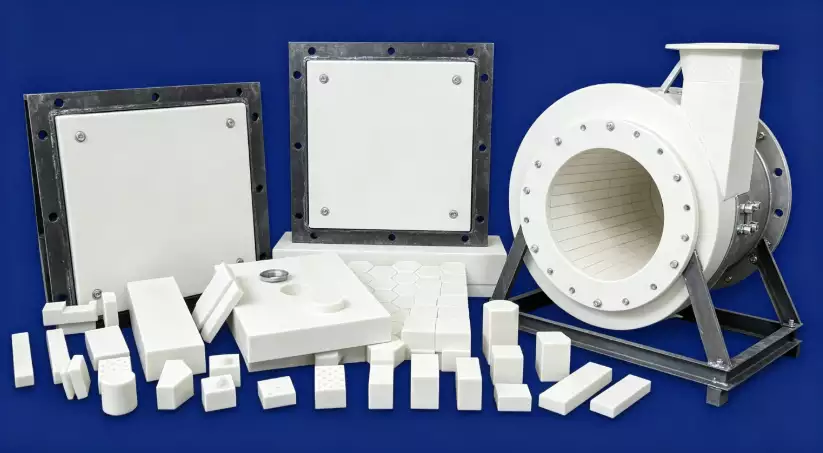
Ordinary carbon steel and stainless steel are the most common structural materials for industrial equipment. Many factories directly use steel plates as inner‑wall protective liners for chutes, pipes and silos due to low initial procurement cost and convenient welding construction. Nevertheless, steel‑based liners show prominent weaknesses under long‑term abrasive‑wear working‑conditions.
Carbon steel features relatively low surface hardness. Under continuous scouring of mineral dust, coal ash and hard granular raw materials, steel liner surfaces will gradually thin, wear through and deform. In many actual plant cases, ordinary carbon‑steel protective plates need partial repair or full replacement within only 3‑6 months. Frequent shutdown for disassembly, welding and component replacement seriously interrupts continuous production schedules. In humid working‑conditions or environments containing acid‑alkali ions, steel liners suffer rust and electrochemical corrosion, accelerating material failure. Stainless‑steel improves anti‑corrosion capacity, but its abrasive‑wear performance is still limited, and unit‑price rises significantly.
High‑purity alumina ceramic adopts high‑temperature sintering forming technology, with Mohs hardness reaching grade 9, second only to diamond. Its anti‑abrasion performance is dozens of times higher than carbon steel. The material loss rate of qualified alumina ceramic parts is merely 1/10‑1/20 of carbon‑steel liner. Under conventional abrasive‑wear scenarios, the service life of ceramic lining can reach more than 5 years; even for harsh high‑abrasion industrial sites, stable service cycles of 3‑8 years are achievable. Long service life greatly cuts the frequency of shutdown maintenance and spare‑part replacement, and improves overall equipment operating rate.
Besides superior wear‑resistance, alumina ceramics possess excellent chemical inertness. They will not rust when exposed to moisture, fly ash or weak corrosive medium, solving the hidden trouble of secondary pollution caused by metal‑oxide peeling‑off from steel‑made liner.
There are also objective limitations for alumina ceramic. Compared with ductile steel, monolithic pure ceramic liner has relatively poor intrinsic toughness and cannot withstand ultra‑large concentrated point‑impact. For heavy‑impact positions, Sanxin New Materials Co., Ltd provides composite‑structure wear‑resistant liner solutions, such as ceramic‑rubber‑steel three‑in‑one composite plates, which combine ceramic wear‑resistance, rubber buffer performance and steel structural strength to adapt to high‑impact complex working‑conditions.
Wear‑resistant alloy, manganese steel and high‑chromium cast‑iron are classic heavy‑duty anti‑abrasion metal materials, widely applied for heavy‑impact equipment protection in mining and metallurgy industries. These alloy materials have much better wear‑resistance than ordinary carbon steel and good metal toughness. However, two major pain points restrict their large‑scale promotion in modern cost‑optimized projects: high comprehensive weight and high long‑term operating cost.
First of all, raw‑material prices of high‑quality wear‑resistant alloy and high‑chromium cast‑iron stay at a high level, bringing relatively high one‑time procurement expenditure. What is more noteworthy is their large specific gravity. Alloy liner weight is huge, which increases static load for hopper, chute and pipeline steel‑structure. Extra load accelerates fatigue loss of equipment support frame, bearing and driving components, and raises power‑consumption of the whole system.
Even though alloy‑material mechanical performance is good, its service life still cannot compare with alumina ceramic products under medium‑to‑high abrasive‑wear environment. Alloy liner still needs regular replacement every one‑to‑several years. Spare‑parts stock, on‑site lifting, welding construction and labor for maintenance accumulate year‑by‑year, pushing up total operational expenditure.
Alumina ceramic components manufactured by Sanxin New Materials Co., Ltd have obvious lightweight advantage. The bulk density of alumina ceramic is around 3.6‑3.9 g/cm³, and the weight of same‑thickness wear‑protection liner is only about one‑third of alloy liner. Light‑weight characteristics effectively lower static load of equipment structure and reduce extra energy‑consumption caused by heavy spare‑parts.
From full‑lifecycle cost perspective, although the unit price of alumina ceramic parts is higher than ordinary steel, they realize “one‑time installation, multi‑year low‑maintenance”. Calculated over 5‑8‑year operation cycles, the comprehensive use‑cost of alumina ceramic liner is far lower than high‑alloy cast‑iron liner.
It should be clearly pointed out that alumina ceramic is not a complete substitute for all alloy wear‑parts. For positions suffering persistent super‑large lump‑material violent impact, alloy‑based materials or ceramic‑metal composite schemes still need to be selected according to working‑condition assessment.
Cast‑stone is an inorganic brittle wear‑resistant material processed through melting, casting and crystallization treatment, once popular for industrial anti‑abrasion renovation. It has high surface hardness and low raw‑material cost, but fatal defects restrict its modern‑industrial application.
Cast‑stone material has extreme brittleness. When subjected to concentrated impact from ore lump, clinker or bulk‑material, cast‑stone liner is easy to crack, fragment and peel off. Once local fragmentation occurs, surrounding liner pieces will lose support and trigger large‑area falling‑off failure. Meanwhile, cast‑stone construction process is complex; on‑site cutting, trimming and partial repair are very difficult. After partial damage happens, the whole‑block component often needs to be removed and replaced, and local patch maintenance can hardly be realized.
Compared with cast‑stone, alumina ceramic produced by Sanxin New Materials Co., Ltd supports modular tile design. Small‑size alumina ceramic tiles can be spliced into ceramic lining for flat, curved, special‑shaped equipment inner‑walls. When partial individual tiles are damaged in long‑time service, only the failed tiles need to be replaced locally, without dismantling large‑area liner. Maintenance workload and spare‑parts waste are greatly reduced. For impact‑prone locations, we adopt ceramic‑rubber composite structure to absorb impact energy and lower brittle‑fracture risk.
Nevertheless, cast‑stone still retains its value in some low‑impact, low‑cost‑priority static silo projects. Plant engineers need to make trade‑offs among investment budget, impact intensity and maintenance accessibility.
Rubber liner is widely applied in many bulk‑material‑handling sites, with prominent advantages of good elasticity, excellent shock‑absorbing performance and low noise. Rubber can effectively buffer material falling impact, but its own performance boundaries are quite clear.
The biggest weakness of ordinary rubber liner lies in limited wear‑resistance and poor temperature‑resistance. Sharp hard mineral particles will continuously scratch and cut rubber surfaces, leading to surface material loss. Under working‑condition temperature exceeding 80 ℃, rubber material will gradually age, soften, harden and lose elasticity, then accelerate wear‑out and peeling. So pure rubber liner is mostly limited to normal‑temperature, light‑abrasion working‑conditions.
Alumina ceramic perfectly compensates rubber’s wear‑resistance and temperature‑resistance shortcomings. High‑purity sintered alumina can stably work under long‑term temperature up to 1000 ℃, and will not be scratched by hard sharp particles. In actual engineering practice, many projects combine the strengths of two materials: Sanxin New Materials Co., Ltd’s ceramic‑rubber composite wear‑resistant liner organically combines alumina ceramic tile surface layer and elastic modified rubber substrate. Ceramic undertakes anti‑abrasion task, rubber provides impact‑buffering function. This composite solution obtains both wear‑resistance and shock‑absorbing capacity, and is widely used for chutes, hoppers and transfer‑point equipment under medium‑impact heavy‑abrasion conditions.
The value of alumina ceramic for industrial production is not limited to extending spare‑part service‑life and cutting maintenance expense. It brings multiple implicit production benefits for factories.
First, dense and ultra‑smooth ceramic surface greatly reduces material adhesion and caking tendency. For silos, hoppers and chutes, it lowers frequency of manual cleaning and eliminates blockage‑caused production interruptions, improving material conveying continuity and production capacity.
Second, excellent chemical stability avoids metal‑ion contamination. In mineral‑processing, fine‑chemical and building‑material production workflows, metal wear debris peeled‑off from steel/alloy liner may mix into finished products and downgrade product quality. In contrast, alumina ceramic hardly releases impurity ions during service, protecting finished‑product purity.
Third, it matches the trend of green and low‑carbon manufacturing. Long service life means less frequent spare‑part production, transportation and replacement work, lowering comprehensive resource consumption and waste‑generation volume.
Although alumina wear‑resistant ceramic has many outstanding advantages, it is not universal for all working‑conditions. Plant engineers need to avoid blind material substitution, and evaluate from multiple dimensions before finalizing wear‑protection liner selection.
Assess impact intensity: Monolithic pure alumina ceramic liner is suitable for scouring‑dominated, low‑to‑medium impact scenarios. For high‑impact working‑conditions, choose ceramic‑rubber‑steel composite liner rather than single‑piece hard ceramic.
Clarify operating‑temperature range: Confirm long‑term continuous temperature of equipment; select corresponding material grade and composite structure according to temperature parameters.
Pay attention to medium‑corrosion property: Alumina resists most weak acid‑alkali medium, but cannot withstand long‑term erosion of hydrofluoric acid and high‑concentration strong alkali. For special chemical‑corrosion environment, material adaptability test is required.
Evaluate installation and maintenance condition: Modular small‑tile ceramic lining is convenient for partial repair; large‑integral ceramic parts require higher‑precision installation.
Evaluate total‑cost‑of‑ownership instead of unit‑price only: Compare full‑lifecycle expenditure including procurement, transportation, installation, maintenance and shutdown‑loss, instead of only comparing one‑time purchasing price.
Sanxin New Materials Co., Ltd recommends customers provide on‑site working‑condition parameters including equipment type, material characteristics, drop‑height, temperature and medium property. Our technical team will give targeted material‑matching suggestions, helping customers obtain optimal balance between project investment and long‑term return.
Traditional wear‑resistant materials such as carbon steel, alloy cast‑iron, cast‑stone and rubber liner all have their own applicable scope and unavoidable performance bottlenecks, which makes it hard to satisfy the comprehensive requirements of modern heavy‑industry for long‑life, low‑maintenance and stable production.
As a mature new‑generation anti‑abrasion material, alumina wear‑resistant ceramics stand out in comparative tests against multiple traditional materials. High hardness brings excellent abrasive‑wear resistance; chemical inertness delivers corrosion‑resistant performance; modular composite‑structure design expands working‑condition adaptability. Ceramic lining and composite wear‑resistant liner manufactured by Sanxin New Materials Co., Ltd effectively solve many common pain‑points such as short service‑life, frequent shutdown‑maintenance and high comprehensive operating‑cost for mining, thermal‑power, metallurgy and cement‑plant equipment.
It is worth emphasizing that alumina ceramic is not an omnipotent material. Material selection must be based on real‑site working‑condition analysis. Reasonable matching of pure ceramic, ceramic‑rubber two‑in‑one, ceramic‑rubber‑steel three‑in‑one composite liner or partial metal‑alloy scheme is the correct path for realizing real industrial cost‑reduction.
With the continuous advancement of global industrial intelligent and energy‑saving transformation, alumina wear‑resistant ceramic products will gain broader application space in equipment anti‑abrasion renovation and new‑construction projects, and empower high‑quality development of heavy‑industry.

Submit your demand,
we will contact you ASAP.

Sanxin New Materials Co., Ltd. focus on producing and selling ceramic beads and parts such as grinding media, blasting beads, bearing ball, structure part, ceramic wear-resistant liners, Nanoparticles Nano Powder


 English
 English
 Russian
 French
 Spanish
 Portuguese
 Arabic