
In cement manufacturing and mineral processing, the ball mill is the most critical core grinding equipment in the entire production circuit, widely applied in cement clinker grinding, raw material grinding, mineral beneficiation, and industrial material ultrafine crushing. As a low-speed rotating cylindrical grinding device relying on steel ball, steel section and other grinding media for impact, extrusion and abrasive crushing, ball mills undertake the key task of converting coarse granular raw materials into qualified fine powder materials, directly determining production line capacity, grinding fineness stability, unit energy consumption and final product quality. Among all operational adjustment parameters, ball mill media charge is one of the most fundamental yet easily overlooked factors. Even a minor deviation of 2% to 3% in media filling level can trigger significant fluctuations in production output, power draw, grinding fineness, and cement consistency, leading to invisible economic losses throughout the entire production line.Many plant operators rely purely on empirical experience or rough estimation to add grinding media, which often results in overfilling or underfilling conditions. Overfilled mills cause cushioning effects, reduce effective impact and grinding force, increase motor load, and waste electrical energy. Underfilled mills lead to insufficient particle collision, unstable fineness distribution, low production capacity, and accelerated liner wear due to direct metal-to-metal contact.Therefore, mastering a simple, accurate, and practical ball mill media charge calculation method is essential for process engineers, shift supervisors, and plant optimization teams. Ball mill operation is a typical energy-intensive process, and media charge configuration is the core factor that restricts grinding efficiency. Reasonable media filling and tonnage matching can form a complete and effective particle crushing and grading system inside the mill, while unreasonable charging will completely restrict equipment performance. This article provides a complete industrial calculation workflow based on real cement plant operational data, including geometric principle analysis, step-by-step precise calculation, field shortcut methods, error analysis, and practical optimization strategies. Whether for daily production inspection, monthly media supplementation planning, or grinding circuit performance tuning, this method can be directly applied to on-site operations.
To ensure authenticity and practicability, all calculation cases in this article adopt actual operating parameters from a large-scale modern cement clinker grinding mill. The given field data conform to mainstream medium and large cement mill specifications, with strong universality and reference value for similar production lines worldwide.Basic Field Parameters
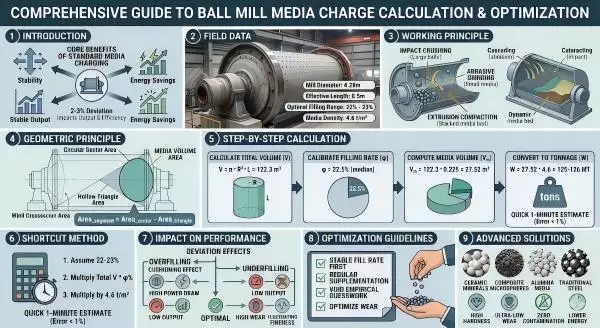
Mill Internal Diameter (D): 4.28 m
Mill Effective Length (L): 8.5 m
Design and Stable Filling Level Range: 22% – 23%
Grinding Media Bulk Density: 4.6 t/m³ (standard steel ball media for cement mills)
These parameters represent the standard working conditions of closed-circuit cement ball mills. The filling level of 22%–23% is the optimal stable range verified by long-term industrial operation, which balances grinding efficiency, power consumption, and equipment service life perfectly.
A horizontal cement ball mill relies on mechanical rotational power and gravity to drive internal grinding media and raw materials for continuous crushing, impact, and fine grinding. The core equipment structure consists of a rotating cylinder, alloy steel grinding media (steel balls of different diameters), wear-resistant liners, partition plates, feeding and discharging devices, and a main drive system. Driven by the motor and reducer, the cylinder rotates at a constant low speed, generally maintained at 15–20 rpm for large cement mills, creating a cyclic motion system for media and materials.During mill operation, the liners fixed on the inner cylinder wall generate friction and lifting force. As the cylinder rotates upward, the grinding media and raw material particles are lifted to a certain height following the liner plates. When the combined gravity exceeds the centrifugal force generated by rotation, the media and materials break away from the running track and fall freely in a parabolic trajectory. This continuous cyclic movement forms three core grinding effects inside the mill: impact crushing, abrasive grinding, and extrusion compression.First, impact crushing: Large-diameter steel balls fall from a high position, generating strong instantaneous impact force to crush coarse granular materials, breaking large clinker and raw ore particles into medium and small particles, completing the primary dissociation of materials.Second, abrasive shearing: Small-sized steel balls and steel sections roll and slide relative to each other in the lower accumulation area. The fine gaps between media produce continuous abrasive and shearing force on material particles, further grinding medium particles into fine powder to meet cement fineness requirements.Third, static extrusion compaction: The stacked grinding media form a dense particle crushing bed. During continuous rotation and extrusion, residual coarse particles are finely ground through multi-point pressure, ensuring uniform particle size distribution of finished powder.In industrial closed-circuit grinding systems, unqualified coarse particles are discharged from the mill outlet, sent to the powder separator for classification, and returned to the ball mill for re-grinding, while qualified fine powder is collected as finished cement products. The entire circulating grinding process ensures high-efficiency and low-fluctuation production. All grinding behaviors, impact intensity, and material grinding efficiency are directly determined by the internal ball mill media charge and filling level, which is why accurate media calculation is the core premise of stable grinding performance.
The traditional misunderstanding of ball mill media charge calculation is simply multiplying the total mill volume by empirical filling percentage. In fact, the grinding media inside a horizontal ball mill does not fill the cylinder uniformly. Due to gravity accumulation, the media forms a stable segment-shaped accumulation section at the bottom of the mill cylinder during static shutdown state. Accurate media volume must be calculated through circular segment geometry theory, which is the core of professional ball mill charge calculation.The principle follows the sector-and-triangle area difference method: the effective cross-sectional area occupied by grinding media equals the area of the circular sector minus the area of the hollow triangle above the media surface. After obtaining the effective cross-sectional area, multiply by the mill effective length to get the total media volume, and finally convert volume to tonnage through media bulk density.This geometric calculation method eliminates empirical errors and is recognized as the most accurate static calculation method in the cement industry, which can truly reflect the actual media reserve inside the mill.
The ball mill is a standard horizontal cylindrical grinding chamber. The total internal volume formula is fixed: Mill Total Volume V = π × R² × LAccording to field parameters: Radius R = 4.28 ÷ 2 = 2.14 m Length L = 8.5 mSubstitute data for calculation: V = 3.1416 × (2.14)² × 8.5 V ≈ 122.3 m³This value represents the total effective grinding cavity volume of the cement ball mill, excluding the space occupied by liners and partition plates, which meets industrial calculation standards.
Based on on-site shutdown observation and segment geometric calculation, the actual stable filling level of the mill under normal working conditions is calibrated to 22.5%, which is the median value of the optimal operating range of 22%–23%. This filling rate is the best balance point for high-yield and low-consumption operation of cement clinker grinding mills.Many on-site operators only use rough estimation, while geometric correction can control the filling rate error within 0.5%, providing precise data support for subsequent tonnage calculation.
After obtaining the total mill volume and accurate filling rate, the effective media volume can be calculated: Effective Media Volume = Total Mill Volume × Filling PercentageEffective Volume = 122.3 × 22.5% Effective Volume ≈ 27.52 m³This volume refers to the actual space occupied by steel ball grinding media inside the mill, including the natural void ratio between stacked steel balls, which conforms to the definition of industrial bulk volume.
The final ball mill media charge weight is obtained by multiplying the effective volume by the standard bulk density of cement grinding media (4.6 t/m³): Media Charge Tonnage = Effective Volume × Media Bulk DensityMedia Charge = 27.52 × 4.6 Media Charge ≈ 125 – 126 MTTherefore, the standard stable ball mill media charge of this 4.28×8.5m cement ball mill is controlled at 125 to 126 metric tons, which is the most scientific and reasonable loading range for long-term stable operation.
In daily plant inspection and quick adjustment scenarios, process engineers do not need to perform complex geometric calculations every time. The cement industry has summarized a mature and reliable shortcut calculation method after years of practical verification, whose calculation results are almost consistent with precise geometric algorithms.Shortcut Operation Steps First, adopt the industry-standard optimal filling range of 22%–23% for medium and large cement mills; second, multiply the total mill volume by the standard filling percentage; finally, convert the volume to tonnage through the fixed bulk density of 4.6 t/m³.The core advantage of this shortcut method is fast calculation, easy memory, and zero professional threshold. Shift operators can complete data estimation within one minute, which is completely suitable for daily media supplement judgment and production dynamic adjustment.Comparative verification shows that the error between the shortcut method and the precise geometric calculation is less than 1%, which is completely negligible for industrial production. It can fully meet the precision requirements of daily production management.
Many production teams ignore the importance of fine-tuning ball mill media charge and believe that small filling level fluctuations will not affect production. However, actual industrial operation data proves that a 2%–3% deviation in ball mill media filling will cause chain changes in multiple core production indicators.
Insufficient ball mill media charge leads to fewer effective grinding points and impact times per unit time, insufficient material refinement capacity, increased grinding circuit circulation load, and directly reduced mill hourly output. Excessive media charge causes the internal material bedding effect, weakens the impact crushing force of steel balls, restricts particle dissociation, and also leads to output decline.
Ball mill is the highest energy-consuming equipment in cement plants, accounting for more than 60% of the total power consumption of the production line. Excessive grinding media loading increases the rotating inertia and operating load of the mill, resulting in a sharp rise in unit power consumption. Too low media charge causes unstable current fluctuation of the main motor, low operation efficiency, and increased unit energy consumption per ton of clinker.
Reasonable ball mill media charge ensures uniform particle grading and stable specific surface area of cement products. Unreasonable filling level will cause fluctuating grinding fineness, unstable cement strength development, excessive residue on the sieve, and inconsistent product quality, affecting product delivery quality and market reputation.
Underfilled mills cause direct collision between steel balls and liners, accelerating liner abrasion and impact damage. Overfilled mills increase the operating pressure of bearings, reducers, and motors, increasing the risk of equipment failure and raising long-term maintenance costs.
Through the complete calculation process and field verification of real cement mill cases, we can summarize the core practical guidelines for ball mill media charge management:First, both precise geometric calculation and field shortcut method can obtain highly consistent ball mill media charge data. Professional geometric algorithms are suitable for monthly fixed inventory, equipment overhaul, and parameter calibration, while shortcut methods are suitable for daily rapid judgment and dynamic adjustment.Second, the optimal filling level of medium and large cement clinker mills is stably controlled at 22%–23%, and the corresponding standard ball mill media charge of 4.28×8.5m mills is 125–126 tons. Maintaining this standard loading range can maximize grinding efficiency and minimize energy consumption.Third, ball mill media charge management must adhere to the principle of "stable filling rate first". Avoid frequent large-scale media addition, and implement regular small-quantity supplementation to keep the filling level floating within ±1% of the standard value, ensuring long-term stable operation of the grinding circuit.Fourth, on-site operators should not rely solely on empirical judgment. Mastering basic geometric calculation principles can help understand the internal material movement law of the mill, accurately judge abnormal fluctuations in output, current, and fineness, and realize scientific and refined process management.
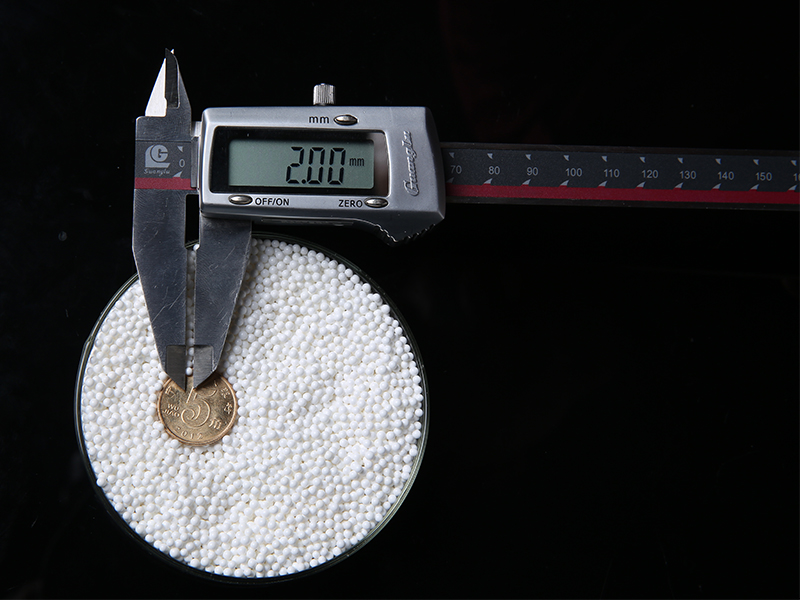
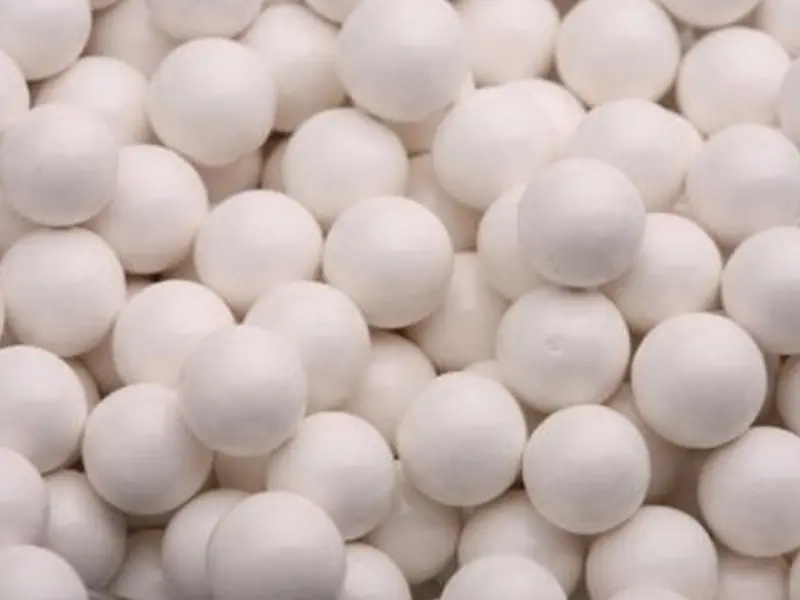
For high-efficiency, long-life ball mill operation, the selection of premium minerals grinding media directly determines long-term operational stability, wear control, and grinding consistency. Unlike conventional steel media, advanced ceramic grinding media deliver exceptional hardness, ultra-low wear rates, zero contamination, and stable performance under the harsh operating conditions of cement clinker grinding and mineral processing.Engineered for ore fine grinding, industrial milling, and heavy-duty mining applications, these high-performance minerals grinding media include specialized ceramic balls, composite microspheres, and high-density alumina formulations designed to maximize grinding efficiency while minimizing media consumption and equipment wear. By integrating premium minerals grinding media into the grinding circuit, plants can maintain consistent ball mill media charge performance, reduce frequent media replenishment, stabilize grinding fineness, lower energy consumption, and extend overall maintenance intervals — creating a more reliable and cost-effective grinding system that complements accurate media charge calculation.
In daily cement plant operation, there are three typical mistakes in ball mill media charge management, which can be avoided through standardized calculation methods.The first mistake is blind media addition based on output decline. Many operators add a large number of steel balls once the output drops, which easily causes overfilling, further deteriorates grinding conditions, and forms a vicious cycle of low output and high energy consumption.The second mistake is ignoring bulk density differences. Different types of forged steel balls and cast steel balls have slight density differences. Fixed density parameters must be adopted during calculation to ensure tonnage accuracy.The third mistake is neglecting media wear loss. Steel balls will gradually wear and become smaller during long-term operation, leading to reduced total weight and decreased filling rate. Regular calculation and supplementary optimization are required to maintain the optimal ball mill media charge state.
Ball mill media charge calculation is a basic but core technical skill for cement plant process optimization. It connects equipment geometry, material physical parameters, and production operating indicators, and is the key entry point for refined grinding circuit management. This article adopts real factory data, sorts out complete geometric precise calculation and field shortcut methods, and verifies that the standard ball mill media charge of 4.28×8.5m cement mill is 125–126 tons under the optimal 22%–23% filling level.Scientific ball mill media charge management can effectively optimize grinding efficiency, stabilize cement product quality, reduce unit power consumption, and extend equipment service life. For modern intelligent and energy-saving cement plants, standardized media calculation and dynamic adjustment are essential means to reduce costs and increase efficiency.Keep the calculation method simple in daily operation, but always master the underlying physical and geometric principles to support long-term process improvement and plant performance upgrading.

Submit your demand,
we will contact you ASAP.

Sanxin New Materials Co., Ltd. focus on producing and selling ceramic beads and parts such as grinding media, blasting beads, bearing ball, structure part, ceramic wear-resistant liners, Nanoparticles Nano Powder


 English
 English
 Russian
 French
 Spanish
 Portuguese
 Arabic