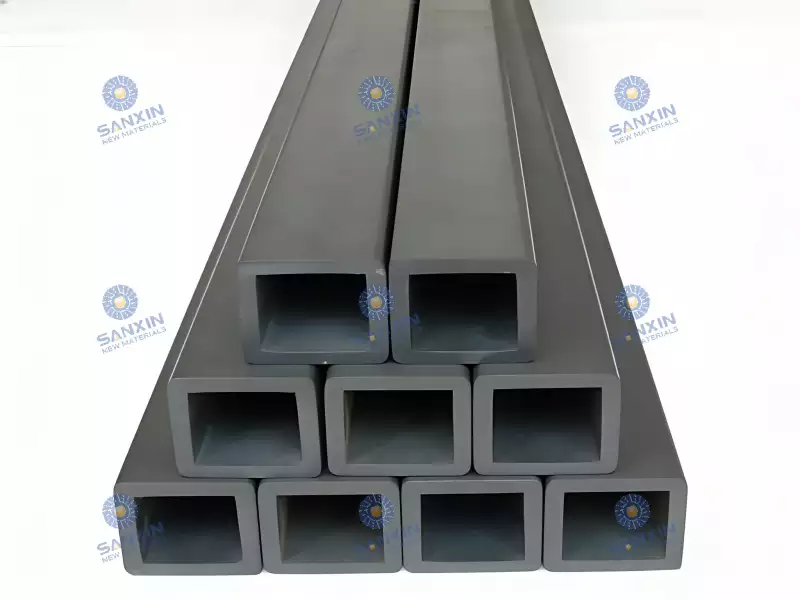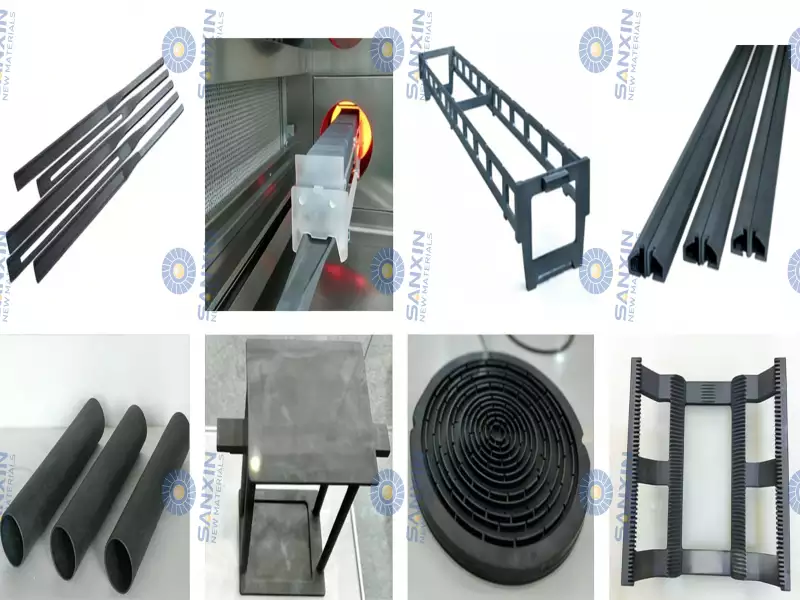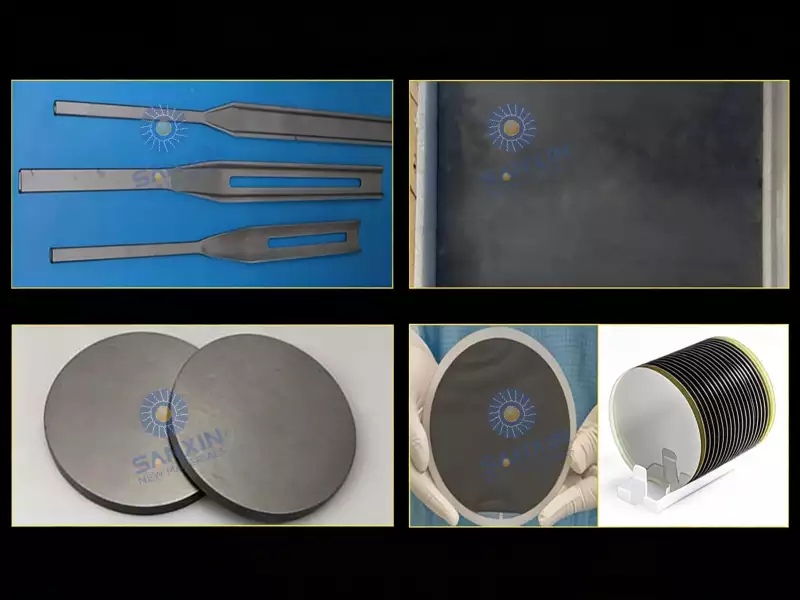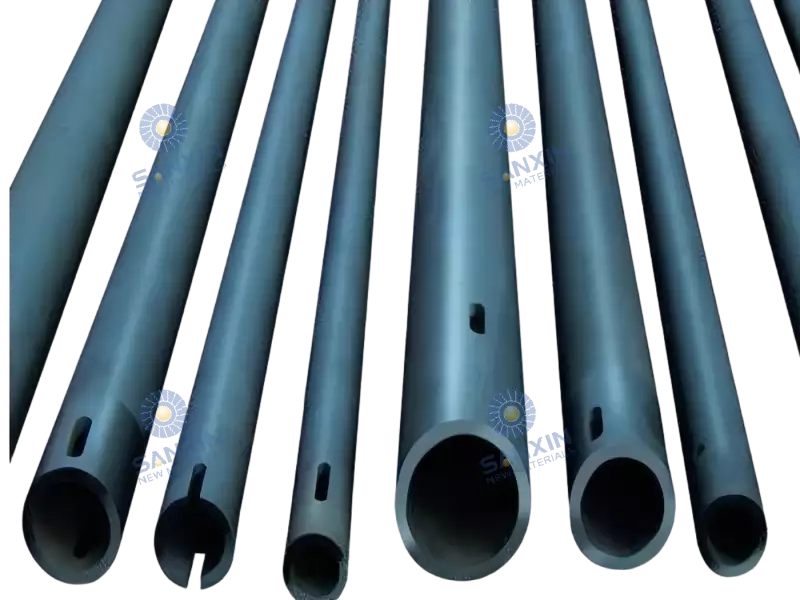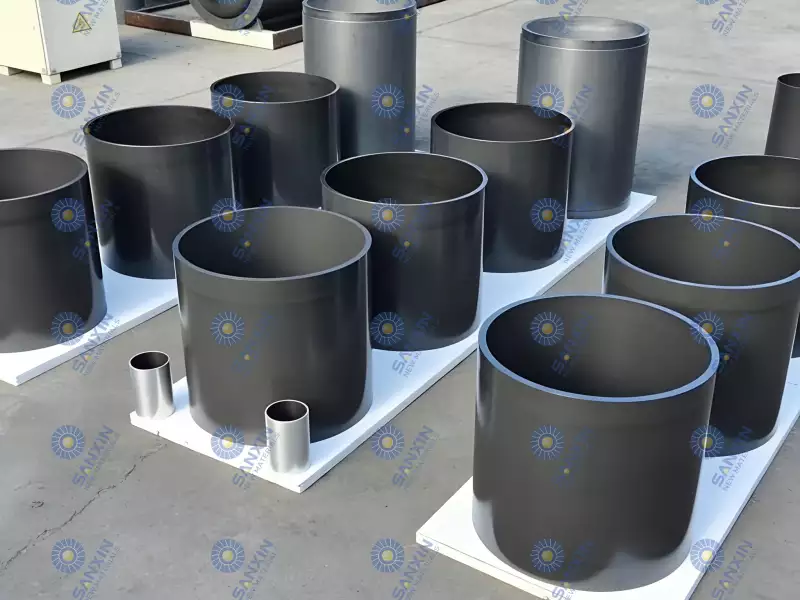

In high-temperature thermal processing—encompassing daily-use ceramics, electrical porcelain, honeycomb ceramics, lithium battery manufacturing, and semiconductor fabrication—robust, dimensionally stable, corrosion-resistant structural support is non-negotiable. Silicon Carbide (SiC) Square Beams and Crossbeams (also called SiC support beams, refractory beams) are the industry gold standard, outperforming traditional alumina (Al₂O₃) and cordierite beams in durability, load capacity, and thermal stability.Manufactured via advanced Reaction-Bonded Silicon Carbide (SiSiC) technology, our SiC square beams withstand extreme thermal environments while maintaining structural integrity. Unlike conventional ceramic beams that soften, warp, or crack under heavy loads above 1200°C, SiC beams deliver consistent performance at continuous operating temperatures up to 1350°C, ensuring reliable workpiece support and alignment in roller kilns, furnace car bottoms, and high-temperature production lines.This SEO-optimized product listing details our SiC square beams/crossbeams, covering material science, technical specs, performance advantages, applications, cost analysis, and customization, tailored for industrial buyers, engineers, and procurement teams in ceramic, lithium battery, and semiconductor sectors.
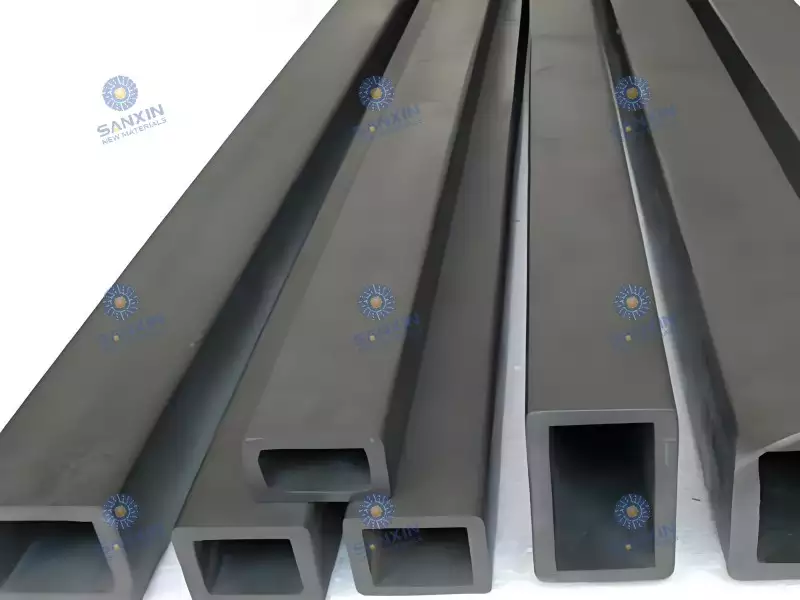
SiC square beams/crossbeams are precision-engineered structural refractory components that provide rigid support, load distribution, and framework for workpieces (ceramic green bodies, battery electrode sheets, semiconductor substrates) during high-temperature sintering, firing, and annealing. Their key functions:
Structural Support: High-load-bearing support for heavy workpiece stacks in kilns/furnaces.
Dimensional Stability: Maintain precise workpiece alignment to prevent warping, sagging, or misalignment during thermal cycling.
Chemical Inertness: Isolate processed materials from corrosive furnace atmospheres to ensure product purity.
Thermal Shock Resistance: Withstand rapid heating/cooling cycles without cracking or deformation.
Our SiC beams use the Reaction-Bonded Silicon Carbide (SiSiC) process: molten silicon infiltrates a porous carbon-bonded SiC preform, reacting with carbon to form additional SiC. The result is a dense, strong, cost-effective ceramic ideal for structural use:
High density (≥2.65 g/cm³) for robust load-bearing capacity.
Superior flexural strength (≥280 MPa at high temperatures) to prevent bending/breakage.
Chemical inertness to acids, alkalis, and common process gases (O₂, N₂, Ar).
Thermal stability up to 1350°C, retaining mechanical properties at extreme heat.
Parameter
Reaction-Bonded SiC (SiSiC) | Industry Standard (Alumina) | |
Max Operating Temperature | ≤1350°C (continuous) | ≤1200°C (limited) |
Density | ≥2.65 g/cm³ | 3.6–3.9 g/cm³ |
High-Temp Flexural Strength | ≥280 MPa | ≤200 MPa (softens significantly) |
Thermal Expansion Coefficient | ~4.2×10⁻⁶ /°C | ~7.2×10⁻⁶ /°C (higher mismatch) |
Service Life | 3–5 years | 6 months–2 years |
Corrosion Resistance | Excellent | Good (prone to oxidation) |
Our SiC beams are manufactured to strict precision standards, with full customization available:
Height (H) ±X mm
Width (W) ±X mm | Tolerance (X) mm | Wall Thickness (mm) | Max Length (L) ±2 mm | |
20 | 20 | ±0.8 | 5.0 | 2000 |
25 | 25 | ±0.8 | 5.0 | 2000 |
30 | 30 | ±0.8 | 5.0 | 3000 |
40 | 40 | ±1.0 | 5.0 | 4000 |
50 | 50 | ±1.0 | 5.0 | 4000 |
60 | 60 | ±1.2 | 6.0 | 4000 |
70 | 70 | ±1.2 | 7.0 | 4000 |
Height (H) ±X mm
Width (W) ±X mm | Tolerance (X) mm | Wall Thickness (mm) | Max Length (L) ±2 mm | |
50 | 20 | ±1.0 | 5.0 | 4000 |
60 | 25 | ±1.2 | 6.0 | 4000 |
70 | 30 | ±1.2 | 7.0 | 4000 |
Parameter
| Specification | |
Use Temperature | ≤1350°C (continuous) |
High-Temp Bending Strength | ≥280 MPa |
Straightness Tolerance | ≤1.0‰ (per meter, working surface) |
Load Capacity (50×70mm) | Concentrated load: 526 kg/m; Uniform load: 1052 kg/m |
Customization | U-channel/L-type design, custom holes/slots, RSiC upgrade for high-purity needs |
SiC square beams maintain structural integrity under heavy loads at extreme temperatures, a critical advantage over alumina:
High-Temperature Strength: SiSiC beams retain ≥280 MPa flexural strength at 1350°C, while alumina loses over 50% of its strength above 1200°C.
No Sagging: A 50×70mm beam supports 526 kg/m concentrated load and 1052 kg/m uniform load, keeping workpieces level and aligned during firing to eliminate warpage and scrap.
Rigid Structure: Square/rectangular cross-section provides optimal rigidity for spanning large kiln car distances.
For lithium battery and semiconductor manufacturing, where purity is critical, SiC beams are irreplaceable:
Zero Ion Leaching: SiC does not react with battery materials (NCM, LFP) or semiconductor substrates, preventing metal ion contamination that compromises performance or yield.
Acid/Alkali Resistance: Resists corrosive atmospheres and ceramic glaze residues, ensuring a long, clean service life.
SiC beams deliver dramatic long-term cost savings through exceptional longevity:
Alumina Beams: Last 6 months–2 years in high-load, high-temperature environments.
SiSiC Beams: Offer 3–5 years of service, a 3–5x lifespan increase.
Cost Savings: Reduces annual replacement costs and maintenance labor by 80–90%, with ROI achieved in 6–12 months.
Each beam is built to the highest industrial standards for automated production lines:
100% Laser Inspection: Verifies straightness (≤1.0‰) for smooth, flat workpiece contact.
Tight Tolerances: ±0.5mm to ±1.2mm dimensional accuracy ensures compatibility with automated handling systems and kiln fixtures.
Ultrasonic Testing: Inspects for internal cracks/defects before shipment.
SiC beams excel in frequent temperature fluctuations (common in shuttle/roller kilns):
Withstand Rapid Cycles: Handles heating/cooling rates up to 20°C/min without spalling or cracking.
Low Thermal Expansion: ~4.2×10⁻⁶ /°C coefficient minimizes thermal stress, maintaining dimensional stability across firing cycles.
We tailor beams to your unique kiln and process needs:
Special Profiles: Custom U-channel, L-type, and irregular designs for specific load distribution.
Integrated Features: Custom slots, holes, and notches for sensor placement, cable routing, or workpiece retention.
Material Upgrade: High-purity Recrystallized SiC (RSiC) for semiconductor/lithium battery ultra-clean requirements.
The most established use case for SiC beams, serving as the backbone of ceramic production:
Ceramic Tile & Sanitary Ware Firing: Robust support for heavy tiles/sanitary ware in roller kilns, preventing beam deformation for a flat glaze surface.
Honeycomb Ceramic Production: Precise, rigid support for delicate honeycomb substrates during sintering, preventing collapse/warping.
Advanced Ceramics: Contamination-free support for high-purity technical ceramics (alumina, zirconia) during firing.
SiC beams meet the strictest purity and stability standards for battery production:
Cathode/Anode Sintering: Supports electrode sheets during high-temperature calcination (1000–1200°C), with non-contaminating properties to preserve battery material performance.
Electrode Drying & Annealing: Stable, heat-conductive support for electrode sheets in continuous furnaces, ensuring uniform moisture removal and density.
High-Voltage Insulator Firing: Preferred for firing large porcelain insulators, with high load capacity and thermal stability to maintain precise shape and electrical properties during vitrification.
Wafer Processing: High-purity RSiC beams for semiconductor diffusion furnaces and PV wafer sintering, with ultra-low metal impurities to protect delicate wafers and boost yield.
Solar Cell Production: Supports silicon wafers during diffusion, doping, and curing, ensuring uniform heating and zero contamination for maximum cell efficiency.
Glass Tempering: Structural support for glass panels during high-temperature forming/tempering.
Powder Metallurgy: Support beams for sintering metal powder components in protective atmospheres.
Requirement
Recrystallized SiC (RSiC) | Reaction-Bonded SiC (SiSiC) | |
Operating Temp >1350°C | ✅ Ideal | ❌ Not Recommended |
Ultra-High Purity (Semiconductor/Battery) | ✅ Premium Choice | ⭐ Good (general use) |
Heavy Load Support (Ceramic Tiles) | ⭐ Good | ✅ Excellent (Cost-Effective) |
Cost-Sensitive High-Volume Production | ❌ Higher Cost | ✅ Excellent Value |
General Industrial Kilns | ⭐ Good | ✅ Standard Choice |
Cost Factor
Alumina Beams | SiSiC Beams | Annual Savings | |
Initial Purchase | $5,000 | $8,000 | -$3,000 |
Annual Replacement | $5,000 | $1,000 | $4,000 |
Maintenance Labor | $2,000 | $400 | $1,600 |
Total Annual Cost | $7,000 | $1,400 | $5,600 |
For a medium-sized ceramic factory, switching to SiSiC beams saves over $50,000 over 10 years, plus higher productivity from reduced downtime and improved yield.
We ensure seamless integration with your existing production line:
Custom Shapes: U-channel, L-beam, C-beam, and irregular profiles.
Precision Machining: CNC drilling, slotting, and notching for automation systems.
Reinforcements: Ribs for extra load capacity in extreme applications.
Drop-In Replacement: Matches standard alumina beam dimensions for easy retrofitting in most kiln/furnace systems.
Maximize beam lifespan with these best practices:
Uniform Support: Ensure full beam support along its length on the kiln car, avoiding overhang.
Proper Alignment: Install beams parallel with precise spacing for even weight distribution.
Load Distribution: Avoid concentrated heavy loads; spread weight across multiple beams.
Regular Inspection: Check for cracks, chips, or residue after each cycle.
Cleaning: Remove debris with compressed air/soft brushes; avoid harsh abrasives.
Temperature Ramp-Up: Preheat kiln slowly (5–10°C/min) to minimize thermal shock.
A: We manufacture standard beams up to 4000mm (4 meters); custom lengths are available upon request.
A: SiSiC works for standard industrial processes; for ultra-high-purity NCM/LFP manufacturing, we recommend high-purity RSiC beams.
A: Load capacity depends on beam size, span length, and workpiece weight. Our engineering team provides custom calculations for your application.
A: Yes, every batch includes a full inspection report with dimensional accuracy, straightness, and strength data.
A: Absolutely, we offer standard sample sizes for process validation.
Silicon Carbide (SiC) Square Beams & Crossbeams are the ultimate high-performance solution for high-temperature industrial structural support, outperforming traditional alumina beams in strength, longevity, and thermal stability. Whether you need SiSiC beams for heavy-load ceramic kilns or high-purity RSiC beams for semiconductor/lithium battery production, our custom-engineered SiC beams deliver significant improvements in production efficiency, yield, and total cost of ownership.
We will contact you as soon as possible!
Silicon Carbide (SiC) Square Beams & Crossbeams

Submit your demand,
we will contact you ASAP.

Sanxin New Materials Co., Ltd. focus on producing and selling ceramic beads and parts such as grinding media, blasting beads, bearing ball, structure part, ceramic wear-resistant liners, Nanoparticles Nano Powder


 English
 English
 Russian
 French
 Spanish
 Portuguese
 Arabic